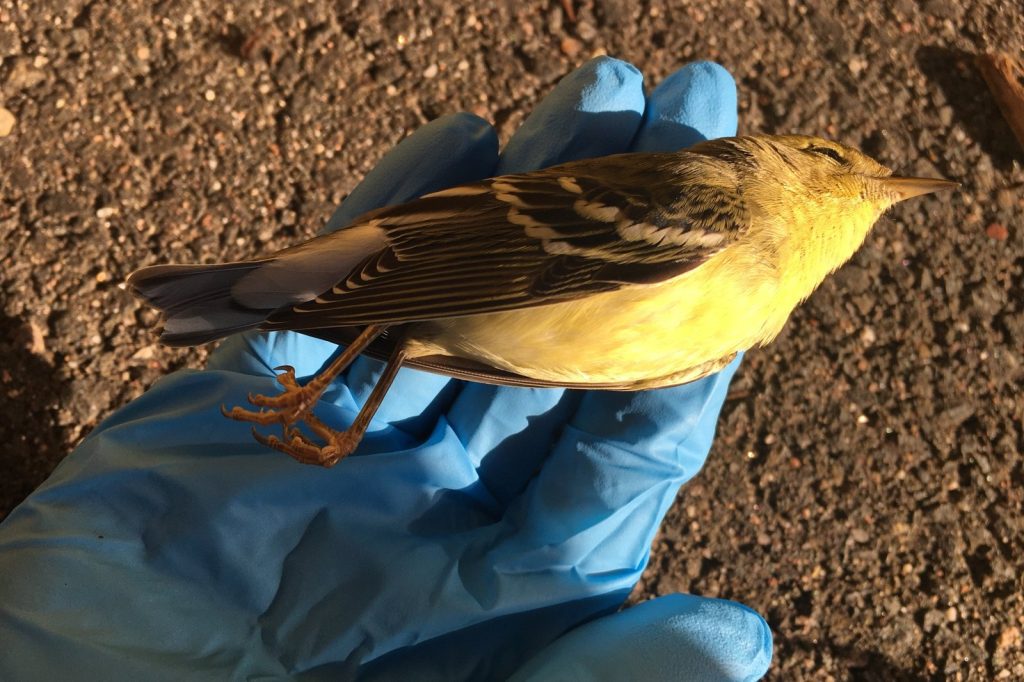
A songbird lying motionless under a window in freezing weather is in more trouble than the same bird on a mild day. In warm weather a stunned bird may sit in the grass for about twenty minutes and then fly off. In snow, wildlife rehabilitators and backyard birders say, body heat drains away within minutes, and a dazed bird is easy prey for outdoor cats, accipiter hawks and corvids.
Their advice is to move quickly and quietly.
Getting the bird inside
Gloves or a small soft towel come first. Approach from behind, low and slow, because a sudden panicked flutter can make internal injuries worse. Drop the cloth gently over the bird so it cannot see; that helps lower its stress level and heart rate. Then cup your hands around the wrapped bird without squeezing the chest. Birds have no diaphragm and breathe by expanding the whole rib cage, so a tight grip can suffocate them.
Take it indoors at once. A shoebox or a small high-sided shipping box works for most backyard species. Punch pencil-sized air holes in the lid and sides before the bird goes in, so there is no shaking later. Line the bottom with a folded paper towel or clean washcloth for traction, add a loosely rolled washcloth shaped into a small donut to keep an unsteady bird upright, and tape the lid shut so it cannot escape into the house.
Put the box in a quiet room away from drafts, family activity and pets, at normal room temperature of 68 to 72 degrees Fahrenheit. In winter, a heating pad on its lowest setting can go under half the box only, so the bird can move away if it gets too warm. Darkness helps too: the guidance describes it as a natural sedative that lets swelling in the brain subside.
What not to do
No food and no water. A concussed bird swallows poorly, and liquid from a dropper, spoon or bowl can go into the lungs and cause fatal pneumonia. Sugar water, honey mixtures, bread, seeds and mealworms are all on the list of things to skip. Keep the bird away from radiators, wood stoves and hair dryers, since sudden swings in temperature strain a body already coping with head trauma.
Resist the urge to stroke it, talk to it or show it to the family. Wild birds read handling as a predator attack. The guidance says the kindest thing is to close the lid and leave.
Release, or a call to a rehabilitator
Give the bird one to two hours of uninterrupted quiet. Fluttering or scratching from inside the box usually means the concussion has cleared.
To release it, carry the sealed box to a sheltered spot, ideally near dense evergreens or a brush pile, set it on the ground, remove the tape and open the lid. Do not toss the bird into the air. A bird with poor depth perception may drop like a stone. Watch for strong, level flight to a nearby branch, matched wing beats, and clear open eyes with no persistent head tilt.
If the bird hops out but cannot fly, or stays motionless after two hours, close the lid. The guidance says that points to more serious internal trauma, broken bones or a detached retina. In the United States, the Animal Help Now Emergency Finder lists licensed wildlife rehabilitators. Canadian readers are pointed to the FLAP Canada Emergency Rescue Guide.
Preventing the next strike
Winter strikes tend to happen when clear glass reflects bare trees, open sky or houseplants. Feeders placed between five and twenty-five feet from a window also give startled birds room to reach full speed before they hit.
The American Bird Conservancy’s Glass Collisions Program says a tight 2 by 2 inch grid of markings on the outside of the glass is the current best practice for small birds such as hummingbirds and kinglets. Other options are vertical paracord curtains spaced two inches apart, exterior paint patterns or decals, and full exterior insect screens. Moving feeders to within three feet of the glass, or beyond thirty feet, also helps. Birds leaving a feeder that close cannot build up enough speed to hurt themselves.