The Comprehensive Economic and Trade Agreement between Canada and the European Union took years to build and nearly collapsed more than once. It has been provisionally applied since 21 September 2017, and it has removed 98% of the tariffs that stood between the two sides. Investment protection was left out of that provisional application.
A long road to the table
The origins stretch back to a 2004 summit in Ottawa, where leaders agreed a framework for a trade and investment enhancement agreement. Talks paused in 2006, then restarted as a broader negotiation. Officials announced the launch of CETA talks on 6 May 2009 at the Canada-EU Summit in Prague. Stephen Harper and José Manuel Barroso signed an agreement in principle on 18 October 2013, and negotiations concluded on 1 August 2014.
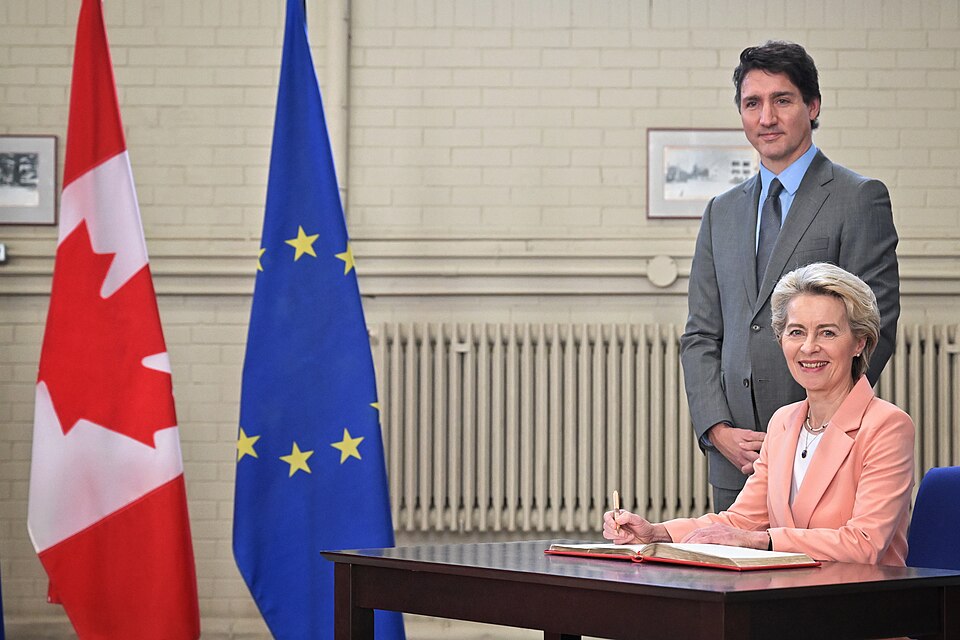
Obstacles kept coming. The Czech Republic, Romania and Bulgaria threatened to withhold support until Canada lifted visa requirements for their citizens. Prague got its wish on 14 November 2013, and Bulgarians and Romanians followed on 1 December 2017. Then, just before the planned signing on 27 October 2016, Belgium said it could not sign because its regional governments had to assent. Justin Trudeau finally travelled to Brussels on 30 October 2016 to sign, and the European Parliament approved the deal on 15 February 2017.
The European Commission projected savings of just over half a billion euros a year in taxes for EU exporters, along with mutual recognition in regulated professions such as architects, accountants and engineers.
Courts and ratification
Because CETA was classed in July 2016 as a mixed agreement, every member state must ratify it nationally. The European Court of Justice ruled on 30 April 2019 that the investor-state dispute mechanism complies with EU law, after Belgium asked for its opinion. In Germany, a constitutional complaint backed by more than 125,000 people reached the Federal Constitutional Court, which allowed provisional application with conditions. The Bundestag and Bundesrat ratified in December 2022.
Ireland was harder. In November 2022 its Supreme Court found by 4-3 that ratification would be unconstitutional under existing law, though amendments to the Arbitration Act of 2010 could fix that. The president signed the Arbitration (Amendment) Act 2026 in June 2026, clearing the way. In March 2026 the CETA Joint Committee also issued narrow interpretations of the investor protections, clarifying what counts as “fair and equitable treatment” and “indirect expropriation”.
What the numbers look like
The EU, with 27 members, more than 450 million people and a GDP of €41.6 trillion in 2025, is Canada’s second-largest trading partner in goods and services. In 2024, Canadian exports to the EU totalled €48.3 billion and imports from it €76.3 billion. The EU is also the second-largest source of foreign direct investment in Canada, at C$194 billion at the end of 2024. Canadian direct investment in the EU stood at C$297 billion, supporting 275,000 jobs in member states.