
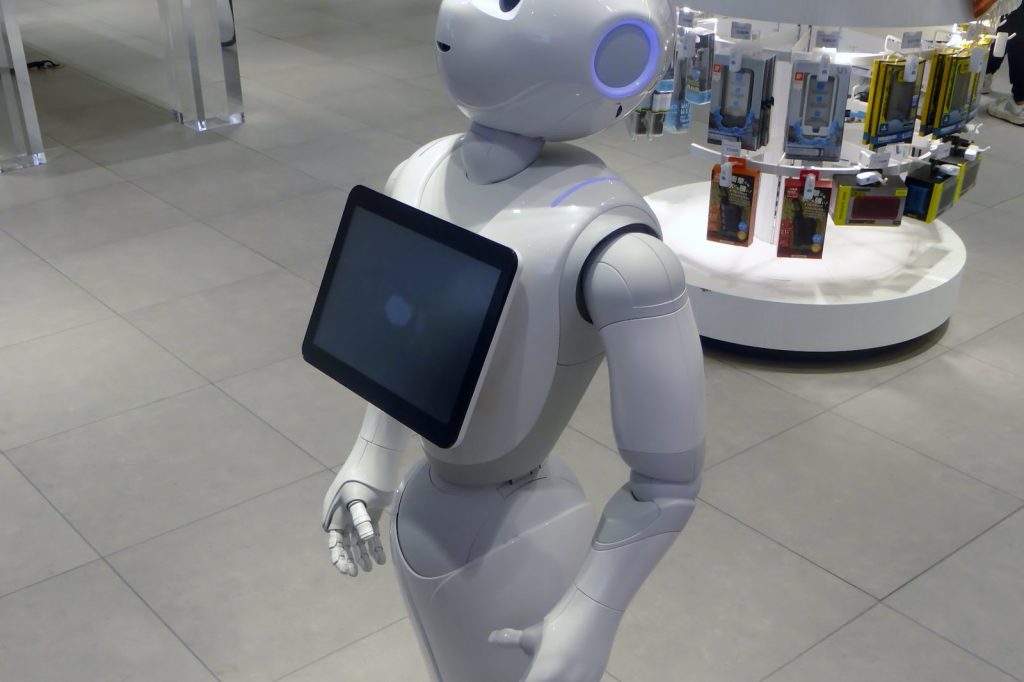
It took one minute. On a Saturday in June 2015, the first 1,000 Pepper robots on sale to consumers in Japan were gone. Most buyers clicked online; 30 units were allocated by a Friday lottery at a Tokyo SoftBank store. Each cost ¥198,000, about US$1,600, and owners also faced ¥24,600 monthly for data and insurance. Ten years later, the company that built Pepper is in insolvency and the robot is no longer made.
SoftBank Mobile and France’s Aldebaran Robotics unveiled Pepper on 5 June 2014 as a personal robot that could read emotions, billed as a world first. It analysed facial expressions and tone of voice, told jokes and danced, and visitors could talk to it at SoftBank’s Omotesando and Ginza stores from the next day.
Early promise in stores
Retailers took notice. WWD reported that seven thousand Peppers were already deployed in Japan, many welcoming customers in SoftBank stores, with another 1,000 across Europe and Aldebaran preparing for North America. At the NRF Big Show, Pepper told the audience it could be “quite the attention getter.”
The money ran out
The business never matched the buzz. Aldebaran, founded in 2005, has lost money every year since 2019, according to heise online, and piled up 150 million euros in debt. RAG-Stiftung, its owner since 2022, abruptly stopped funding it in the summer of 2024. By mid-February 2025 it was in the hands of insolvency administrators. Half the staff were made redundant.
Pepper’s own numbers tell the story. Development stopped in 2021 and sales ended in 2024. Total sales came to 17,000, short of what the company had hoped. Heise noted that each unit costing 17,000 euros or more, up to 20,000, was steep for a robot used mostly in research and entertainment. The smaller Nao, at 5,000 to 10,000 euros, fared better. About 20,000 have sold, and it stays in production along with a wheeled service assistant called Plato.
Left with a robot that may not work
Many Pepper owners are universities, which liked the robot because it was quick to set up and affordable. Now they are worried. The robot has to reach Aldebaran’s AI cloud to run at all, and if the company can no longer pay to keep that going, the machines stop. Software updates have already been discontinued. Repairs are uncertain too: Pepper tends to overheat, forcing cool-down breaks of up to 30 minutes, and its rigid plastic shell is fragile. If support ends, heise warned, Pepper could turn into costly electronic junk.
The rescue plan was meant to find a buyer. If no one steps in and the RAG-Stiftung adds no money, heise reported, Aldebaran will be liquidated and its patents sold.
Sources
- No more Nao and Pepper robots? Aldebaran Robotics insolvent (heise online)
- Aldebaran insolvency process: Universities fear continued use of Pepper robot (heise online)
- SoftBank, Aldebaran to launch humanoid Pepper robot (Telecompaper)
- 1,000 Pepper robots sell out in a minute on launch day (CIO / IDG)
- Meet Pepper, the Robot That's Going to Revolutionize Stores (WWD)




