In the spring of 1997, a toy shop could sell a tiny plastic egg faster than it could stock one. F.A.O. Schwartz moved 30,000 Tamagotchis in its stores in three days. QVC sold 6000 in five minutes. On the black market, the gadgets fetched hundreds of dollars, though shelf prices ran only $15 to $18.
The idea behind them was an odd one: a pet that could die. Akihiro Yokoi, president of the toy design firm WiZ, wanted to fix a flaw in the virtual pets of the day, which were fun but asked nothing of their owners. Real animals, he reasoned, are a lot of work. He put the cute share of owning a pet at 20 to 30 percent of any given day, and called the rest a pain.
An egg on a keychain
The spark was a TV ad about a boy who could not bring his turtle along on a trip. He worked with Aki Maita of Bandai, whose sales and marketing division had scored a hit with Power Rangers. TamaVault reports that his first pitch to Bandai was turned down. His research in Tokyo’s Shibuya district showed that handheld games were designed almost entirely for boys, so the new device had to be cute enough for a young woman to clip to her bag.
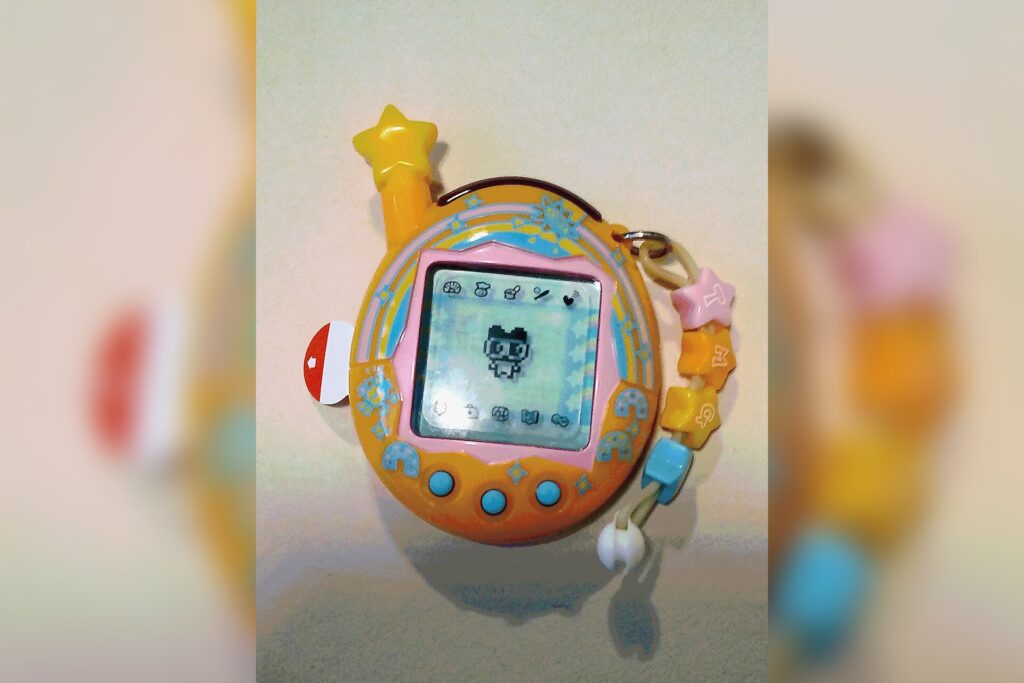
The wristwatch plan gave way to an egg-shaped keychain with three buttons. The name joins tamago, the Japanese word for egg, with watch.
Japanese shops began selling it on November 23, 1996, and 400,000 units had gone by year’s end. Then the North American launch arrived on May 28, 1997, and the numbers jumped. TamaVault counts ten million units by July 1997 and nearly forty million by spring 1998, with Japan and overseas buyers roughly level.
Beeps in the classroom
The creature slept at night and beeped when it was hungry in the day. Ignore it for five or six hours and it could die. The first American model had no pause button, so children carried the device to school, where teachers soon tired of pupils checking on their creatures every few seconds. Bans followed in schools in Japan, America, Europe and Australia. Mental Floss described adults caught up too: Japanese businessmen cancelling meetings to tend their pets, and a driver in a Tokyo suburb who crashed when his Tamagotchi began crying for attention.
Death was the sticking point. In Japan a neglected pet became a ghost hovering over a tombstone. For the American version, Bandai swapped that image for wings and a flight home to a planet millions of miles away, though many children read the wings as an angel’s. Parents reported kids mourning. Parents and child psychologists complained, and Bandai added a pause button, and in 1998 online cemeteries became common.
Nintendo’s Shigeru Miyamoto was watching closely. “I thought that Mario 64 had lost to Tamagotchi,” he said.
The long tail
The boom cooled in Western markets by 1998 and Furby took over the toy aisle, but the franchise never stopped. Bandai relaunched it in 2004 as the Tamagotchi Connection, with an infrared port so that two units could communicate. The Tamagotchi On followed in 2019 with Bluetooth app connectivity, and the Tamagotchi Uni in 2023 was the first with built-in Wi-Fi. As of July 2025, TamaVault says, more than 100 million units had been sold worldwide.
Sources
- A Brief History of the Tamagotchi (Mental Floss)
- The History of Tamagotchi: 29 Years from 1996 to Today (TamaVault)