
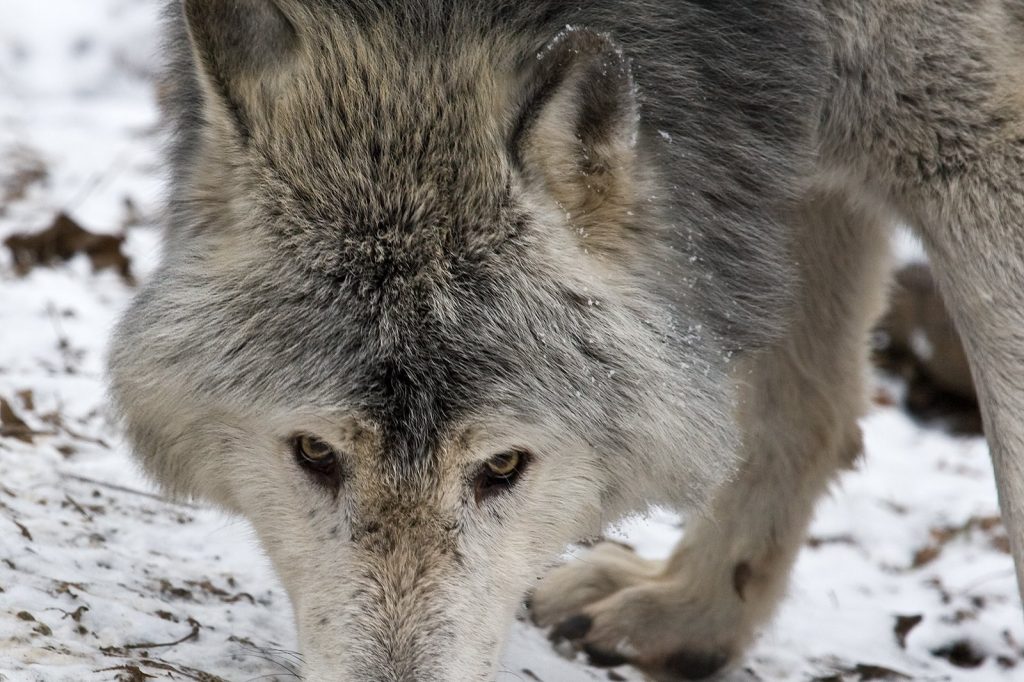
Wisconsin’s wolf count came in at 1,162 this winter, spread over 321 packs, and the state’s biologists say it is no longer climbing. The Department of Natural Resources (DNR) put the figure 5% below last year’s and 3% below the five-year average.
Lydia Margenau, a DNR wildlife research scientist, described the movement as a slight fluctuation around a mean. To her, that suggests the population has reached its biological carrying capacity. The numbers were presented on June 25 at a virtual meeting of the Wolf Advisory Committee, which Randy Johnson, the DNR’s large carnivore specialist, led. Johnson said the full monitoring report would be posted to the DNR website in the coming days.
This is an estimate with margins. The agency’s confidence range runs from 1,026 to 1,307 wolves and from 287 to 359 packs. Wolves that live outside packs, or that have wandered beyond the core wolf range, are left out.
Where the wolves are
The far north and northwest, Zone 1, has the most: 511. The northeast’s Zone 2 has 273 and the central forest’s Zone 5 has 191. Zone 3 in the northwest has 126, and Zone 4 in the northcentral and northeast has 54. Seven more were not assigned to a zone.
Packs average 2.54 wolves in Zone 4 and 4.34 in Zone 1. Territory size splits the same way. Packs in Zones 1 through 4 hold about 54 square miles each, while those in Zone 5 hold 32, a pattern seen in past years. Margenau said the likely cause is more prey in the central forest.
How the DNR counts
Since 2020 the agency has used an occupancy model. Inputs come from winter tracking surveys by staff and volunteers and from GPS collars. The DNR pulls collar locations by satellite. According to DNR research scientist Danielle Deming, 45 collars were active in June, 15 of them put on this year.
Survey crews logged 503 tracking surveys over 17,771 miles of road in the 2025-26 winter. Ninety-seven percent of the blocks were visited at least three times. Winter is the best time to do it: the population is at or near its yearly low, and tracks are easiest to follow.
Legal status
The DNR files an annual wolf report, partly because the U.S. Fish and Wildlife Service requires it. Wolves in Wisconsin and most other states have had federal Endangered Species Act protection since February 2022, when a federal district judge restored it. No wolf hunting or trapping has happened in the state since February 2021. A lawsuit by wolf advocates succeeded in state court that October.
Efforts to delist the wolf continue on three fronts: an appeal of that ruling, a bill called the Pet and Livestock Protection Act that has cleared the U.S. House and now sits in a Senate committee, and a rider on the fiscal year 2027 Interior appropriations bill.
Johnson reported 19 verified wolf conflicts and 15 verified depredations on livestock so far in 2026. For all of 2025 the figures were 32 and 22. The DNR says a wolf has never attacked a person in modern Wisconsin history.
Sources
- What's the Wisconsin wolf population? DNR issues latest estimate. – AOL
- What's the Wisconsin wolf population? DNR issues latest estimate.




