
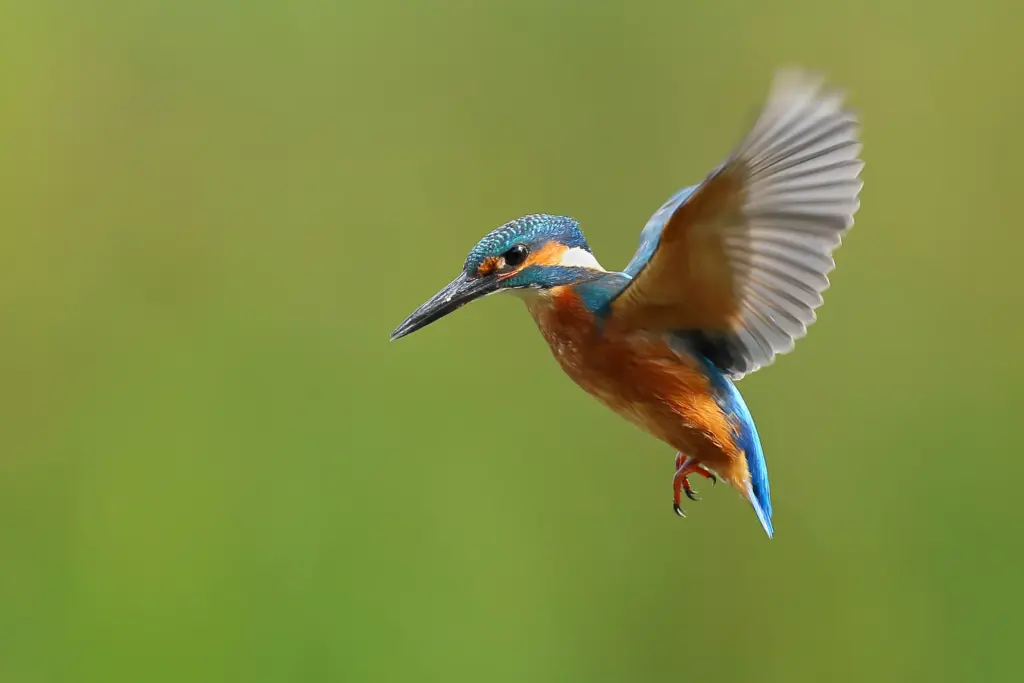
Look up at dusk and something is flapping past. Most people say bird. But flight has appeared in the animal world at least four separate times, and only one of those four is a bird.
Science World in Vancouver lists the four groups: insects, bats, birds and pterosaurs. None came from a flying ancestor. Each started with creatures that could not fly at all, which makes flight a textbook case of convergent evolution, where unrelated animals end up with similar traits because they live similar lives.
Bats, the odd mammals
Bat Conservation International makes a short point: among mammals, only bats truly fly. The order’s name, Chiroptera, comes from the Greek for “hand” and “wing”. That is not a metaphor. Science World explains that bats kept the five separate digits inherited from mammal ancestors, while birds lost theirs, their bones fusing into a wing.
The detail that matters is control. A bat can move its wings separately, whereas a bird’s wings behave more like mirror images. Science World says that makes bats extremely agile, able to change course as much as ten times quicker than a bird. Bats number more than 1,500 species, rank second among mammal orders by size, and live on six continents.
They earn their keep, too. The conservation group estimates that insect-eating bats may spare U.S. farmers roughly $23 billion every year, through less crop damage and less pesticide spending. A typical bat can eat up to half its body weight in insects, and a nursing mother up to 100 percent of hers each night.
The gliders that only look like fliers
Then there is the flying squirrel, which doesn’t fly. National Geographic is blunt about it: the animal glides, relying on a furry membrane, the patagium, stretched from wrist to ankle. Leap from a tree, spread the limbs, and the loose skin opens into a square, a living hang glider. Flights run anywhere from 150 to 500 feet, tree to tree, away from ground predators.
A squirrel can steer by lowering one arm, helped by a piece of cartilage reaching from the wrist to prop up the membrane. Owls are the threat, and the squirrel can swing round 180 degrees in mid-air to evade them. The long, fluffy tail steadies the glide, and flipping it up acts as a brake. There are about 50 species, from North America down into Central America and from Southeast Asia and the north of that continent up into Siberia and Scandinavia.
Science World draws the line clearly. Gliders are not true fliers. Whether their descendants might eventually become true fliers is, as the group puts it, an exciting mystery. For now the sky is shared by four lineages that each solved the problem in their own way.
Sources
- The Evolution of Flight | Science World
- Flying squirrels, facts and photos | National Geographic
- Bats 101 | Bat Conservation International




