
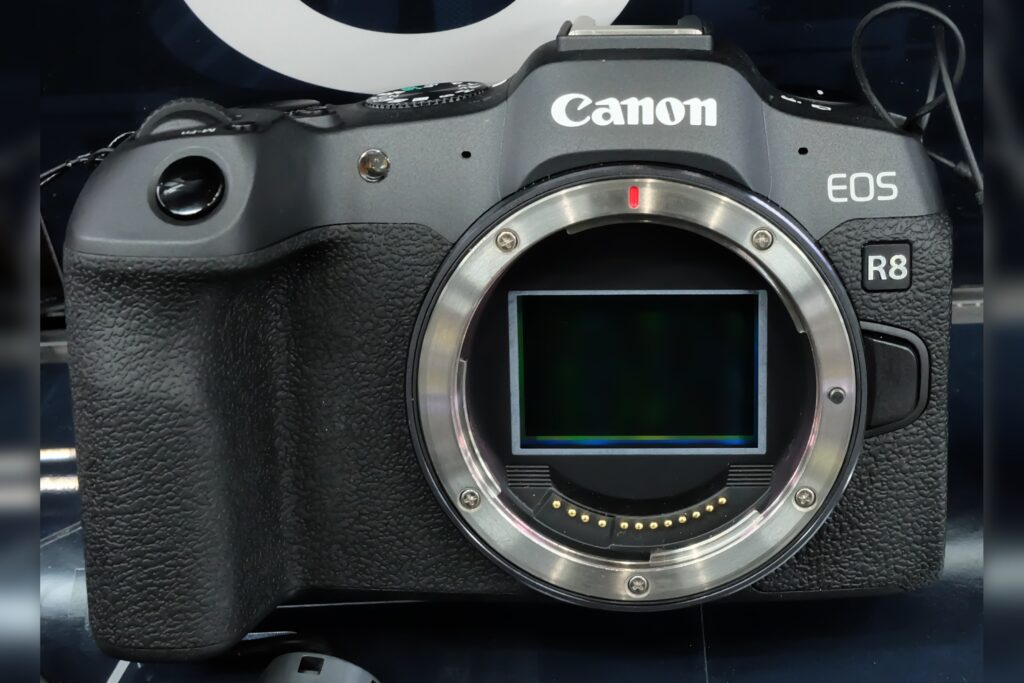
MELVILLE, September 17 — Canon has announced the EOS R8 Mark II, a full-frame mirrorless camera that finally brings in-body image stabilisation to the R8 line. The company unveiled the camera on September 15, with shipping set for late October. Body-only pricing sits at $1,899.
IBIS is the headline. Canon has positioned stabilisation as the defining upgrade and the central motivation for the Mark II’s development, answering the most common criticism of the original EOS R8 — a capable full-frame body with one glaring omission.
The Mark II weighs 546 grams with battery and card, which Canon U.S.A. says makes it the lightest EOS camera body to feature IBIS.
A familiar sensor, a rebuilt body
Under the hood, the technical reality is one of targeted iteration rather than generational overhaul. The 24.2-megapixel full-frame CMOS sensor and Dual Pixel CMOS AF II carry over unchanged from the original R8. What Canon rebuilt is the outside: the redesigned exterior is more angular than its predecessor, though the familiar EOS silhouette with its viewfinder hump remains intact.
Stabilisation, smarter controls and faster connectivity arrive without the body growing. Reviewers have flagged the addition of an autofocus joystick as one of the most meaningful ergonomic upgrades, giving direct control over focus point selection without navigating menus.
Canon also deepened the buffer and upgraded wireless connectivity to Wi-Fi 6 — both useful for burst shooters and on-location file transfers.
Accessories and what to watch
Three accessories launch alongside the body. The EG-E2 Extension Grip, priced at $99.99, arrives in late October and improves handling when larger RF lenses are mounted. The Speedlite EL-5 Ver.2, approximately $379 and also due in late October, is an updated hot-shoe flash with tighter integration into Canon’s latest bodies.
Canon is also announcing a Dual Pixel 3D Converter, which reportedly uses Dual Pixel sensor data to enable depth-based processing and creative effects, though specific workflow details remain unclear and are expected in later Canon documentation. The kit with the RF24-50mm F4.5-6.3 IS STM lens is $2,099, with both configurations expected to be available in late October 2026.
That puts the camera in buyers’ hands roughly six weeks after the September 15 announcement. Because the sensor carries over, the real tests will be IBIS performance and video reliability under sustained use. The EOS R8 Mark II competes in a full-frame mirrorless market where in-body stabilisation has become a key differentiator, and its $1,899 body-only price positions it below many stabilised full-frame rivals.
The original R8 lacked IBIS — a notable gap for handheld video and low-light stills. For prospective buyers, the value proposition rests on whether IBIS and the ergonomic and connectivity upgrades justify the price in a crowded field.
Image quality and autofocus performance should be familiar; stabilisation, controls, buffer depth and wireless speed are the areas of change. The 546-gram weight matters for travel and event photographers, and Canon’s decision to keep the sensor and autofocus unchanged while adding stabilisation reflects a targeted upgrade strategy. Watch for independent IBIS testing and the fuller Dual Pixel 3D Converter documentation when the camera ships in late October.




