
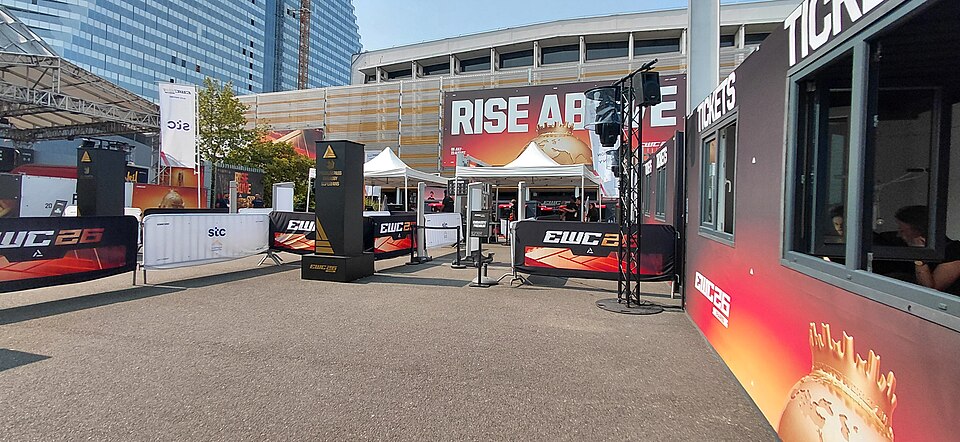
Deep inside the Expo Porte de Versailles in Paris, past the roaring crowds and the Team Vitality jerseys, there is a level of the Esports World Cup most ticketholders never see. It is the players lounge, where hundreds of competitors, club managers and organisers unwind between matches, sometimes after a scheduled massage or manicure. One of the people behind it is Hans Jagnow, Director of Clubs, National Teams and Player Relations at the Esports Foundation.
“The core function of player hospitality is to enable them to be the best on stage,” Jagnow told Rolling Stone. “We want them to be rock stars.”
Six weeks and a plane to Riyadh
This year the job came with a scramble. The Foundation moved the entire tournament from Riyadh to Paris in a handful of weeks. Jagnow has a habit of landing in that kind of situation. In his three years at the Foundation he has been the person called when a puzzle needs a quick but graceful answer. For the first Esports World Cup, he said, the CEO, Ralf Reichert, asked him to support an undisclosed project, “and suddenly I was on a plane to Riyadh.” He had a couple of weeks to prepare the announcement. “I’m the person that gets called when you have six weeks, and you need to bring something to life.”
Scale was no stranger either. Ahead of the 2024 tournament in Riyadh, he posted that the event would run eight weeks and bring about 1,500 players within 2,250 club representatives from over 100 nationalities, competing in 22 tournaments for a $60 million prize pool. His hospitality plan included a 21-floor player hotel with 866 rooms, two lounges, physiotherapy areas and more than 30 hospitality specialists. His team had worked eight months on it.
From a grandmother’s chaperone to a federation
His own route in was unusual. In 2000, at 11, he talked his grandmother into accompanying him to an age-restricted Counter-Strike tournament in Germany, where youth protection law was waived if a guardian came along. “She had no idea what this was,” he said. He later studied law in Berlin and interned in Washington, D.C., including visits to the World Bank and the German Embassy, where he learned that diplomacy is everything. After eight years in politics he noticed esports had no political representation, and he helped launch the German Esports Federation. A stint at ESL, building international partnerships in Counter-Strike, came before the Esports World Cup.
Designing for tired athletes
The Paris hospitality centre has private chefs, baristas, day beds, a barbershop and noise-dampening quiet rooms. Jagnow says nothing in it is there for show. “Everything in here has a function, a role, an intent.”
The reasoning is about strain. A grand final can last five or six hours. Travel is the worst part, he said: arrive Sunday, media day Monday, practice Tuesday, play from Wednesday, and if you go all the way, the next flight leaves the following Sunday. Some top Counter-Strike players travel up to 270 days a year. So the lounge offers pool, ping pong and darts as a counterweight. “Mental focus is really exhausting. It’s like doing pull-ups for hours and hours.” There are massages and physiotherapy, and manicures too, since cameras point at players’ hands all day. The approach draws on William Guidara’s idea of “Unreasonable Hospitality”.
The Heroes Club
The Foundation also looks past game day. Its Heroes Club admits champions: of about two thousand competitors in 2026, roughly 100 will win gold. Win once and you are a hero; win three times and you are a legend with lifetime status, including access to the Heroes Lounge each year. Hilton gives members diamond status. Because 2026 is the third Esports World Cup, there is exactly one legend so far, Moroccan-Canadian Rocket League player Samy “dralii” Hajji, who won for Team BDS, Karmine Corp and now Team Falcons. For Jagnow, that is the point. “Once they’re out of the jersey, they’re still a legend, even post-career.”
Sources
- How the Art of Hospitality is Changing Esports Players' Lives
- In a couple of hours, the most ambitious project in esports will start: the ESPORTS WORLD CUP will officially launch into 8 weeks of esports action, hosted in Riyadh. The EWC24 is 90% longer than… | Hans Jagnow | 31 comments




