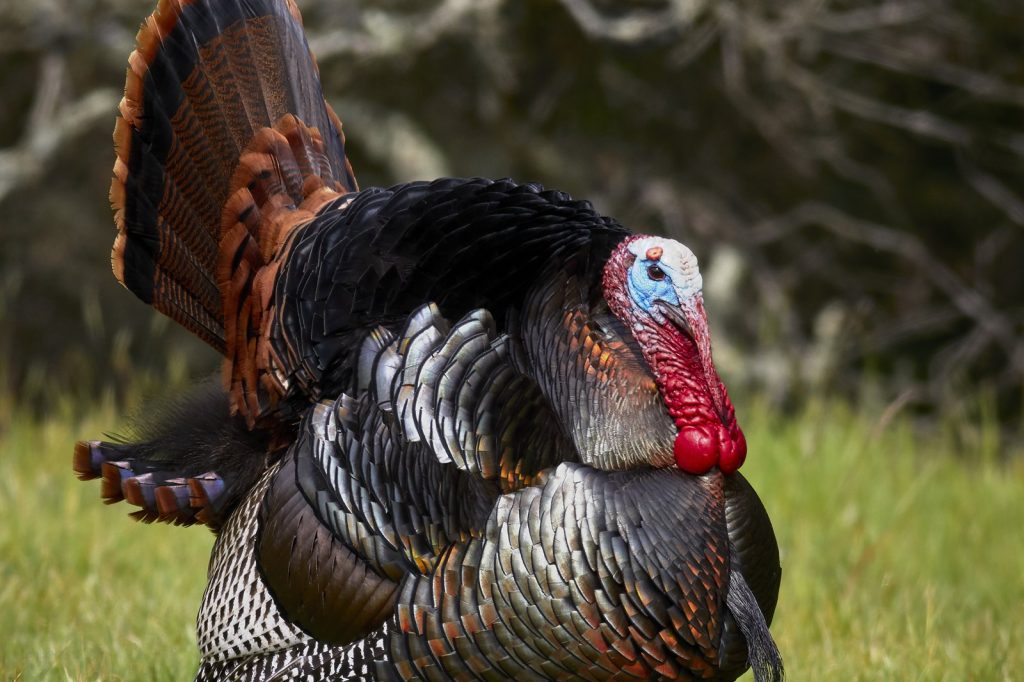
By 1900 there were no wild turkeys left in Michigan. Settlers had hunted them out. Today the birds live in every county in the state, and an estimated 200,000 of them roam its woods and fields.
“We now have wild turkeys in every county in the state, and you can hunt them in every county,” said Alan Stewart, director of the Nimrod Education Center at Hillsdale College. He spent 50 years as a wildlife biologist with the Michigan Department of Natural Resources, specializing in upland game birds, and retired in 2021. “This wild turkey restoration is considered to be one of the most successful of any wildlife restoration activities in the country.”
Netting birds and moving them
Early attempts to bring the birds back used pen-raised turkeys and mostly failed, Stewart said. That changed after World War II, when rocket netting, which fires a net over a flock, made wild birds far easier to catch. In the 1950s Michigan began transplanting turkeys from the Appalachians in Pennsylvania.
Some 54 of them went to the Allegan area. By 1965 numbers were high enough for a very limited permit hunt, though few birds were taken. Biologists later moved birds from Allegan to start flocks near Baldwin and Mio. Those did well too, even though they were north of the turkey’s historic range, which ran from Bay City and Muskegon southward.
The push got serious around the early 1980s. In 1983 outside turkey experts flew over Michigan and concluded the state had some of the best potential in the country for restoring the species. Michigan picked up Missouri birds, using prairie chickens from Kansas and otters from Louisiana as trade goods with Iowa. “That was the sort of horse-trading that went on,” Stewart said.
Turkeys for moose
Ontario wanted turkeys of its own and offered moose from Algonquin Provincial Park. Moose had once ranged across the Upper Peninsula before settlement removed them. “We gave them four turkeys for every moose,” Stewart said. “I always figured we gave them a turkey for each moose leg and they threw in the body for free.”
The deal produced the Michigan Moose Lift of January 1985. Crews used helicopters to flush moose onto frozen lakes, tranquilized them and flew them in harnesses 16 miles to a base camp. Trucks then hauled them nearly 600 miles west to an area west of Marquette. Twenty-nine moose, 10 bulls and 19 cows, made the trip in 1985, and 30 more followed in 1987. A 2023 DNR survey counted 426 moose in the Upper Peninsula.
Hunting and numbers
Michigan holds two turkey hunts a year, in spring and fall. In 2023, nearly 75,000 spring hunters took just under 34,000 turkeys. About 27,000 fall hunters took nearly 3,700. Hunters draw licenses in turkey management units around the state.
Numbers and harvests have held fairly steady over the past decade. The DNR wants to keep populations where they are and look at hunting season rules “to streamline regulations, provide desired hunting opportunities and keep success and satisfaction high,” said Adam Bump, the department’s upland game specialist. Officials also want to keep encounters with turkeys in towns and suburbs from becoming a problem.
The DNR credits partners including the National Wild Turkey Federation for the comeback. It says people can help by volunteering on public land stewardship, planting food plots, or joining summer turkey population monitoring.
Sources
- Wiped out in Michigan, wild turkeys gobbled their way back — and brought the U.P. moose
- From Extinction To Abundance: Wild Turkeys Flourish In Michigan