
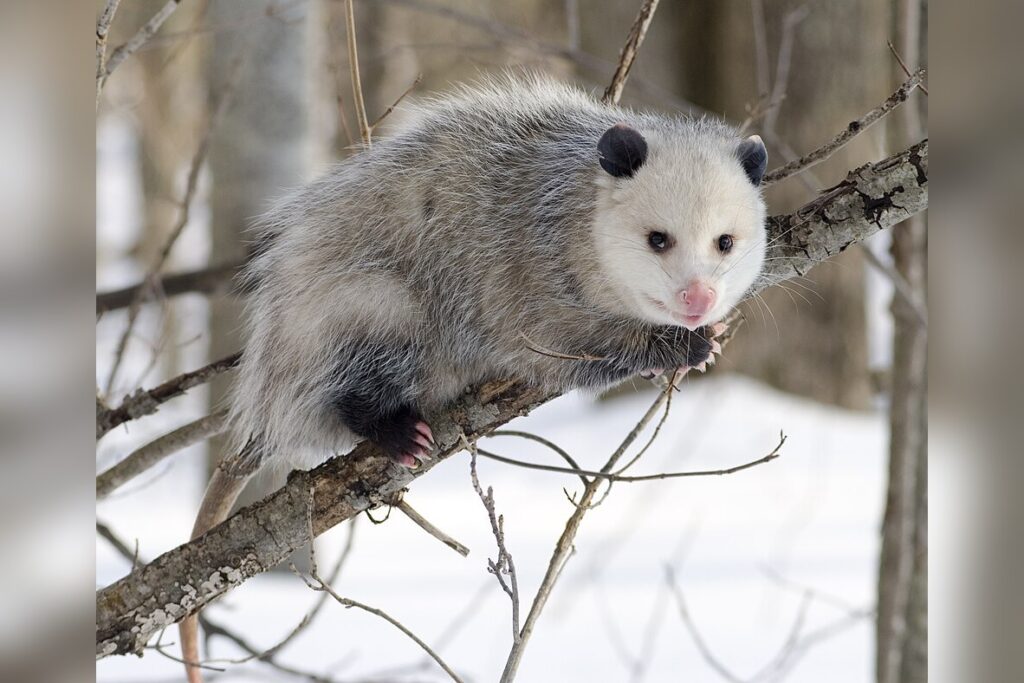
Ask a wildlife keeper whether opossums are cuddly and the honest reply is a shrug. The Virginia opossum, the only marsupial living north of Mexico, is not built for company. According to the Smithsonian’s National Zoo, it is nocturnal and solitary, out and about between dusk and dawn.
So why does anyone wonder? Think of it like a misread signal. An adult opossum that meets a threat has a short menu: bare its teeth, hiss, screech or run. One that does none of those is simply not bothered, and a person standing nearby may read that calm as friendliness.
Where the bond is real
The closeness opossums do have is between mother and young. A litter can number from four to 25 babies, each about 14 millimeters long at birth. They crawl into the mother’s pouch right away and stay there roughly two months, until they are fully developed. Later, Mental Floss notes, the bigger joeys ride on her back, shifting between that perch and the pouch’s warmth.
Female opossums in warm climates can raise three litters a year, though two is the average. It is a frantic schedule for an animal that in the wild may live only 1.5 to 2 years.
Playing dead is not a performance
Another source of confusion is the famous “play dead” routine. It is no act. Mental Floss describes an involuntary, comatose-like state triggered by stress, one the animal cannot start or stop at will; it can last for hours. The zoo adds that mostly young opossums do it.
Not quite the hermit of legend
Yet the loner label may be too tidy. A 2015 study in Biology Letters by Brazilian researchers in Recife watched captive opossums share dens even when they were not mates. One group held 13 white-eared opossums of varied ages under a single roof. The scientists suspect wild males and females may build nests together.
The practical upshot for a backyard visitor: an opossum is unlikely to want a lap, but it is not looking for a fight either, and it keeps itself clean. Like a house cat, it grooms often with tongue and paws. It also makes a good neighbour: it eats roughly 90 percent of any ticks latching on, and a single animal can consume 5000 of them in a tick season, according to the National Wildlife Federation figure Mental Floss cites.
Sources
- Virginia opossum (Smithsonian's National Zoo and Conservation Biology Institute)
- 13 Facts About Opossums (Mental Floss)




