
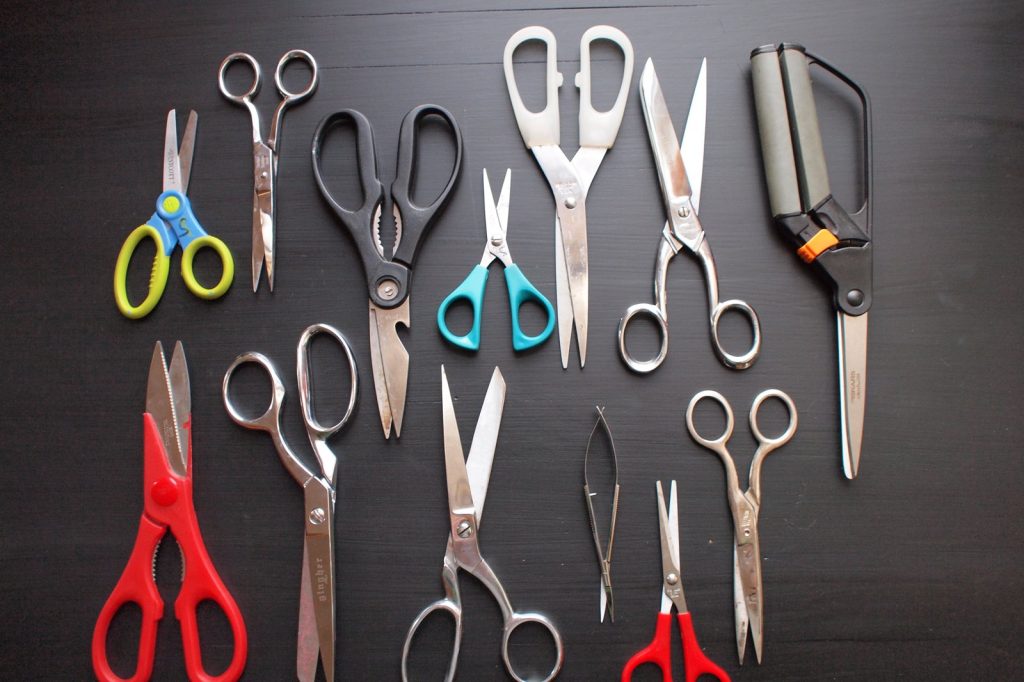
The earliest known scissors turned up in the Middle East some 3,000 or 4,000 years ago. They were the spring type: two bronze blades joined at the handles by a thin curved strip of bronze, which pushed the blades apart when released and brought them together when squeezed. Scissors from the fourteenth century B.C.E. have been found in ancient Egypt.
The Romans invented cross-bladed scissors around C.E. 100. Pivoted pairs, in bronze or iron, with the blades joined at a point between tips and handles, were in use in Rome, China, Japan and Korea. Europe stuck with the spring design until the sixteenth century, and the idea survives in almost all modern scissors.
Mass production came late. Robert Hinchliffe of Cheney Square, London, made the first modern pair from hardened, polished cast steel in 1761, and is reputed to have been the first man to hang a signboard calling himself a “fine scissor manufacturer.” In the nineteenth century, blades were still hammered out by hand on indented surfaces called bosses, and the rings of the handles, known as bows, were punched through the steel and widened on the pointed end of an anvil. Fiskars, the Finnish firm that began as an ironworks in 1649, started its cutlery works in 1830 and introduced new scissor-making methods in 1967.
Scissors or shears
People use the two words as if they were one. Strictly, they are not. Scissors have blades shorter than 15 centimetres, or 6 inches, and finger holes that are usually the same size. Shears have longer blades, and the handles are often unequal: a small hole for the thumb, a larger one for two or more fingers. Shears are generally meant for heavier material such as leather.
Most scissors are not especially sharp. What cuts is the shearing action between the two blades. Children’s scissors are blunter still, often with plastic protecting the blades and rounded tips.
Mechanically, scissors are a double lever with the pivot as the fulcrum. Put the material close to the pivot and the force at the blades goes up. If the hand is twice as far from the pivot as the paper, the paper meets twice the force the hand applies. Kitchen scissors push the fulcrum farther from the handles for more leverage, enough that a good pair will cut through a chicken’s breastbone.
The left-handed problem
Because the blades overlap, scissors are not symmetrical, whatever the shape of the handles. In the right hand, the thumb and fingers naturally press the blades together. In the left hand, the same pair tends to force them apart, and the cutting edge hides behind the top blade so the user cannot see the line being cut. The result can be marks, sores and eventually calluses on the hand. Some left-handers get by holding the scissors upside down.
Scissors sold as ambidextrous usually are not. Most are still right-handed in blade orientation. Genuinely ambidextrous pairs need double-edged blades and a handle swung almost 360 degrees, and patents have been awarded for them.
A tool for every job
The specialist list is long. Pinking shears have serrated blades that leave a saw-tooth edge so cloth does not fray. Tin snips go through sheet metal. Pruning shears and loppers handle branches, and wool shears take a fleece off a sheep without harming it. Trauma shears, also called “tuff cuts,” are used in emergency medical response and rescue. Sewing scissors often have one sharp point and one blunt, for fine work on fabric, and nail scissors have curved blades.
Sharpening them is a trade of its own. A scissor grinder repairs and sharpens blunt knives, scissors and other cutting tools, an apprenticeship profession that still calls for plenty of experience.




