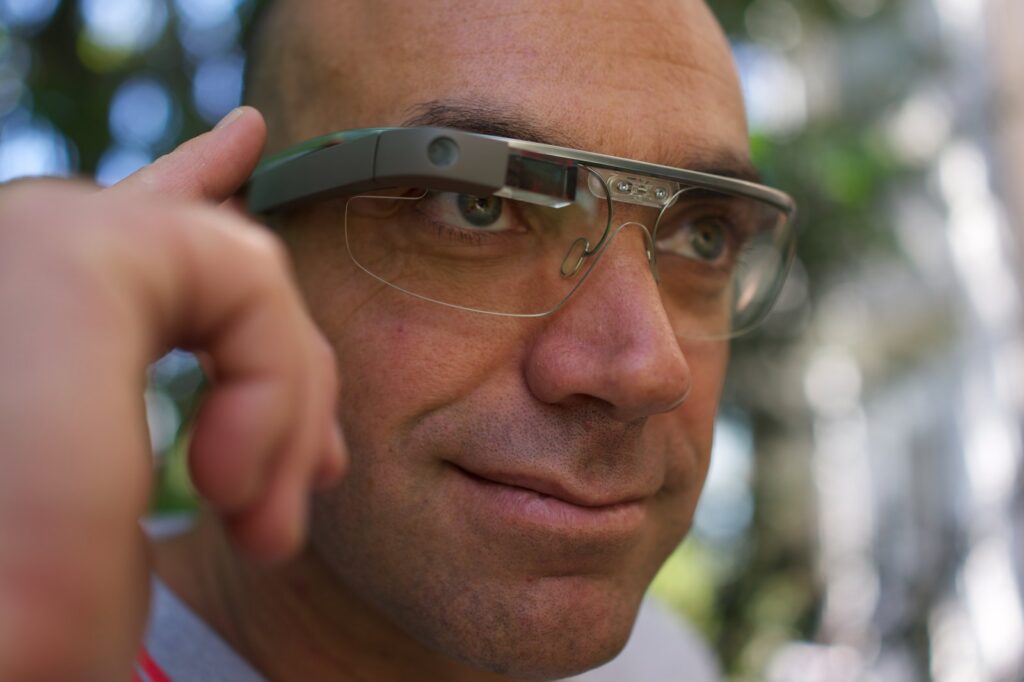
Smart glasses give themselves away, as ever, through the engineering. Under the hood sits a camera, a battery, a processor and speakers, and all of it has to live somewhere inside a frame that is meant to pass for ordinary eyewear.
What to look for on the frame
The technical reality is bulk. Look at the temples and the outer edges of the lenses, where the frames tend to run thick. The camera usually sits at the outer edge, and any ports or grilles are further back along the arm. This is a tendency, not a rule, and slimmer designs exist.
Most models also carry a small LED that lights while they record. That is the detail that matters, and also the one you cannot count on. Cheap lookalikes sold on TikTok Shop and Temu are reported to skip the recording light altogether. Going the other way, audio-first pairs such as the Ray-Ban Meta Audio Glasses have no camera at all, so a smart-looking pair may be incapable of filming you.
Reading the wearer
Behavior helps when the hardware does not. Someone quickly pressing the temples of their glasses, murmuring quiet commands to nobody, or pausing now and then to zone out as if reading text only they can see may be working a display. There is a small chance all of that is unrelated. People mutter and stare into space without help from a gadget.
That staring has a technical explanation. Augmented reality overlays computer graphics on the real world, unlike virtual reality, which tries to replace it. Headsets do this with optical see-through displays, in which you view the world directly through optics such as semi-transparent mirrors while projected content is added on top, or with video passthrough, in which cameras capture the scene and a screen shows it back to you. Either way, the system leans on sensors, cameras and inertial measurement units among them, to pin virtual content to the room. The idea is old: the Virtual Fixtures system, built at the US Air Force’s Armstrong Laboratory in 1992, is counted among the first functioning examples.
The registration question matters in other settings too. Aegis Rider’s Vision motorcycle helmet, priced at $2,000, puts glasses in front of the rider’s eyes, and a critic at RideApart called that a distracting in-between space. The company says its spatial anchoring keeps data fixed on the road rather than glued to the visor.
Apps and manners
Software has joined the contest. Nearby Glasses and ZuckOff scan for Bluetooth devices and the identifiers commonly tied to AI glasses. Neither is dependable: a wearer who has switched Bluetooth off will not show up, and false positives occur. Treat them as a first line of defense.
Suspicion is not proof, so confrontation is a poor opening move. If someone near you is raising alarms, move away, and speak to the authorities if you are being followed. A host running a confidential meeting can simply state that smart glasses are not permitted. And if you must ask a stranger whether they are recording you, do it calmly and in public.
Sources
- The Best Ways To Tell If Someone Is Using AI Glasses
- Augmented reality
- This Augmented Reality Motorcycle Helmet Looks….Unsafe
Photo: Loïc Le Meur (CC BY 2.0)