The Tamagotchi has a new heir, and this one has a camera. Starboy, from a company called lilguy, is a keychain pet that the maker describes as a creature trapped inside a star. It costs between about $140 and $600, depending on the body: stainless steel, aluminum or brass.
Under the hood
The technical reality is a fairly serious sensor package for a trinket. Lilguy says the AI is machine learning built to pick up faces and hand gestures through the built-in camera. A microphone, temperature sensor and accelerometer handle sound, temperature changes and speed. The display is an AR-coated 400×400 OLED, and each unit carries an engraving on the back.
Behaviour runs on Lark, a custom behavioural system and animation engine with more than 500 animations built by Disney animators. Each Starboy is shipped with one of 5,000 possible pairs of eyes, assigned at random.
Unlike a Tamagotchi, there is no feeding routine. You coax emotions out of it through its eyes. A thumbs up checks the battery, and flipping it the bird makes it cross. Loud music can leave it anxious, and too long in the cold upsets it. Starboys within Bluetooth range can swap eyes and pass firmware updates between themselves, “like a virus”, in the words of maker Daniel Kunts.
As ever, the detail that matters is that this is a toy dressed as jewellery. It is sold through the lilguy website, and the price is steep for what amounts to an animated keychain.
What it descends from
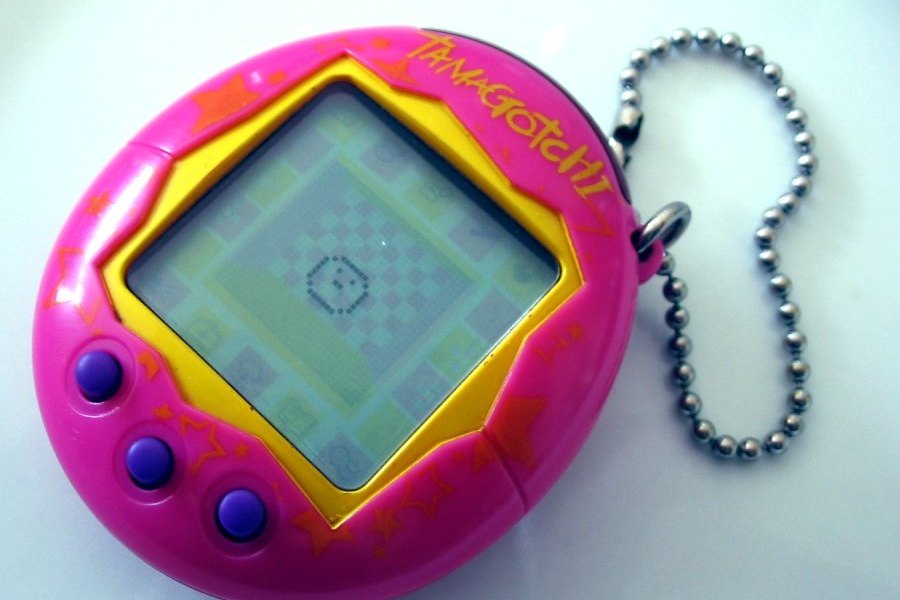
The original Tamagotchi, from the Japanese “tamago” (egg) and “watch”, was created by Akihiro Yokoi of WiZ and Aki Maita of Bandai. It went on sale in Japan on November 23, 1996. Its characters were drawn in the heta-uma style before being converted to pixel art. The interface was three buttons, and the goal was to raise a pet through its life stages. Bandai first aimed it only at teenage girls, and WiZ and Bandai later made a boys’ counterpart, the Digital Monster, which led to Digimon.
The first run sold about 40 million units, 12 million of them in the US and Canada. Demand was so fierce that Bandai staff were barred from carrying bags with the company logo for fear of theft. By 1998 the fad had faded, and overproduction left Bandai with a 6 billion yen loss. The brand came back in 2004 and has sold over 98 million units as of 2025.
Meta’s entry
Starboy is not alone. At Meta Connect 2026, Mark Zuckerberg closed the event with a “one more thing”: the Muse Charm, a round keychain device with a fingerprint scanner for talking to an AI creature called Muse. Meta says Muse will be able to write messages on Instagram, Facebook and WhatsApp. Few details were given. Zuckerberg said it should arrive around the holidays, and it has no price yet.
Sources
- Miss Your Tamagotchi? Meet The Keychain Digital Pet For 2026
- Tamagotchi
- Miss Your Tamagotchi? Meet The Keychain Digital Pet For 2026 – BGR
Photo: Tomasz Sienicki [user: tsca, mail: tomasz.sienicki at gmail.com] (CC BY-SA 3.0)