
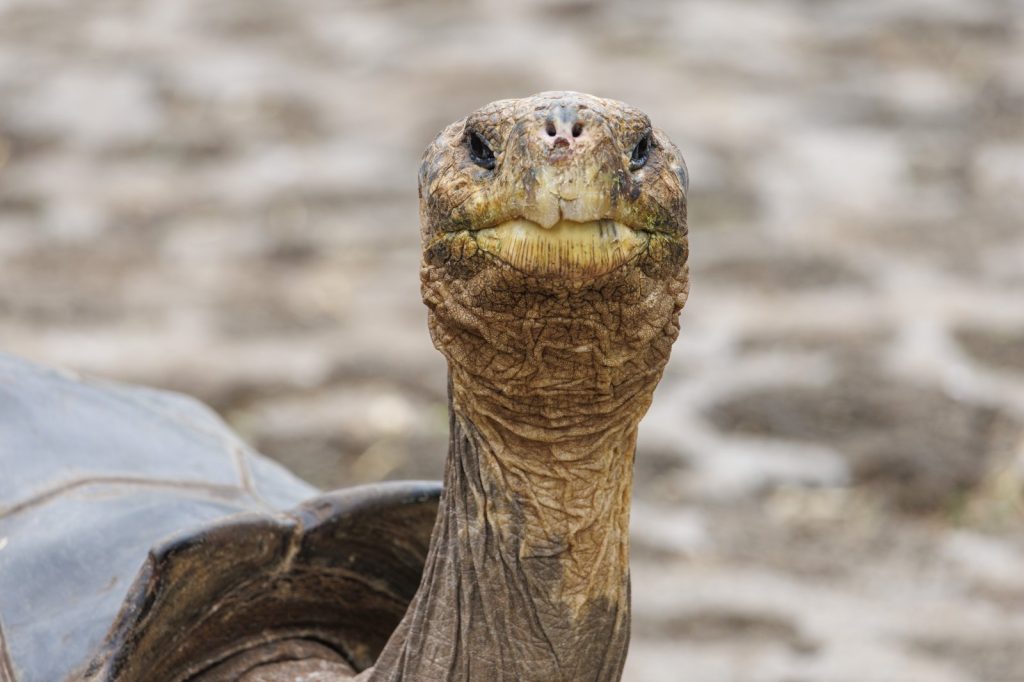
On 20 February 2026, 158 young giant tortoises were carried onto Floreana Island and set down in the highlands. The island had gone without them for more than 180 years.
The Floreana tortoise, Chelonoidis niger niger, was gone by about 1850. Pirates and whalers had been stopping in the Galápagos for centuries, and the tortoises made ideal cargo. They could survive up to a year without food or water, so sailors stacked them in the holds and ate them as they went. “And when these people wanted to eat, the tortoises were simply there, ready to go, and they had fresh meat,” Jorge Carrión of the Galapagos Conservancy told CNN. In two centuries the archipelago lost an estimated 100,000 to 200,000 of them. Floreana had extra troubles: goats, cattle and donkeys stripped the plant cover, and rats, pigs and dogs raided nests and young.
The strange tortoises on a volcano
The comeback begins with an oddity. In 2000, James Gibbs led researchers up Wolf Volcano, at Isabela’s northern end, and found tortoises whose shells looked wrong for the area. “We called them aliens because we didn’t know what they were,” Gibbs recalled. Blood samples went to geneticists at Yale, who agreed the animals did not match the known local species. Four years later, further work tied them to Floreana.
How they got there is guesswork. Carrión offered two theories. Flash floods might have swept animals between islands. More likely, in his view, was human error: Isabela was the last stop for ships before the Pacific, and crews that found a vessel overweight may have thrown tortoises overboard.
Nineteen of the Floreana-lineage animals went to the Fausto Llerena breeding center, working since 1965. Their descendants were bred, with the aim of producing a population genetically as close as possible to the original.
A release on an inhabited island
This is not an empty nature reserve. About 160 people live on Floreana, and the restoration project, led by Ecuador’s environment ministry and the national park directorate, leans on them. Residents sat through planning workshops, helped with biosecurity and joined monitoring. Tortoises come first among 12 native species slated to return. The wider Floreana Ecological Restoration Project is, in Island Conservation’s words, the largest restoration effort ever attempted in the Galápagos.
Lorena Sánchez, the park’s director, described it as “one of the greatest challenges undertaken by the Galápagos National Park”, and spoke of years of rigorous study and patience. Verónica Mora, a community representative from Floreana, put it more simply: the return shows what is possible “when a community leads and many partners come together with a shared purpose.” Her neighbours depend on the island for tourism, agriculture and fishing.
The tortoises are meant to do more than walk about. Carrión calls them “ecosystem engineers.” A single animal eats up to 225 kilograms of vegetation a year, and because digestion takes about a month, the seeds are deposited kilometres from where they were eaten. Gibbs added that many plants germinate poorly unless they have passed through a tortoise first.
Patience is built into the exercise. Tortoises grow slowly, Gibbs said, but they are constant, and he reached for the fable of the hare. Captive breeding in the islands has put back over 9,000 of the animals in 60 years. Floreana’s 158 are the newest.
Sources
- Endangered Tortoises Released onto Floreana Island, Galapagos (Island Conservation)
- These alien tortoises are back on a Galapagos island where they had been extinct since the 19th century (CNN)
- Galapagos tortoises were hunted by pirates for food and went extinct on Floreana Island (Times of India)




