
The political struggle over whether to open or close the U.S.-Canada border to commerce is older than Canada itself. More than a century before the two nations traded $916 billion in goods and services in 2023, Canadian voters went to the polls in 1911 to decide whether to accept a reciprocity deal with the United States — and rejected it decisively. That rejection set the stage for decades of protectionist tariffs that would not fully unravel until a free-trade agreement was finally secured in 1987.
From Reciprocity to Protectionism: A Century of Debate
The question of free trade versus tariffs has animated Canadian politics since 1866, when the Canadian-American Reciprocity Treaty of 1855 — which had significantly boosted cross-border commerce — came to an end. In the treaty’s wake, Canada turned to tariffs.
Prime Minister John A. Macdonald’s Conservative Party introduced the National Policy in 1879, erecting high tariffs designed to shield Canadian manufacturing from American competition. That protectionist posture became a defining feature of Canada’s economic strategy for generations.
By 1911, the issue erupted into a full-blown election showdown. The Liberal Party proposed a reciprocity agreement with the United States, and President William Howard Taft negotiated the deal.
But the Conservatives, led by Robert Borden, opposed it fiercely, warning of American economic domination. Canadian voters sided with the Conservatives, handing Borden a decisive victory and sending a clear message that economic integration with the giant neighbor to the south was not yet welcome. The debate resurfaced in the 1984 and 1988 federal elections.
The Progressive Conservative Party championed a free trade agreement with the United States, while the Liberal Party stood in opposition. The 1988 election effectively became a referendum on free trade, and the Progressive Conservatives prevailed.
That victory ended a century of tariff-based protectionism and set the stage for the Canada-United States Free Trade Agreement, implemented in 1987. The 1987 accord then laid the groundwork for the North American Free Trade Agreement in 1994.
A $916 Billion Economic Arteries
Today, the U.S.-Canada trade relationship stands as one of the world’s largest commercial arteries. In 2023, U.S. exports to Canada reached $440 billion, while Canadian exports totaled $476 billion, producing a $36 billion trade deficit for the United States.
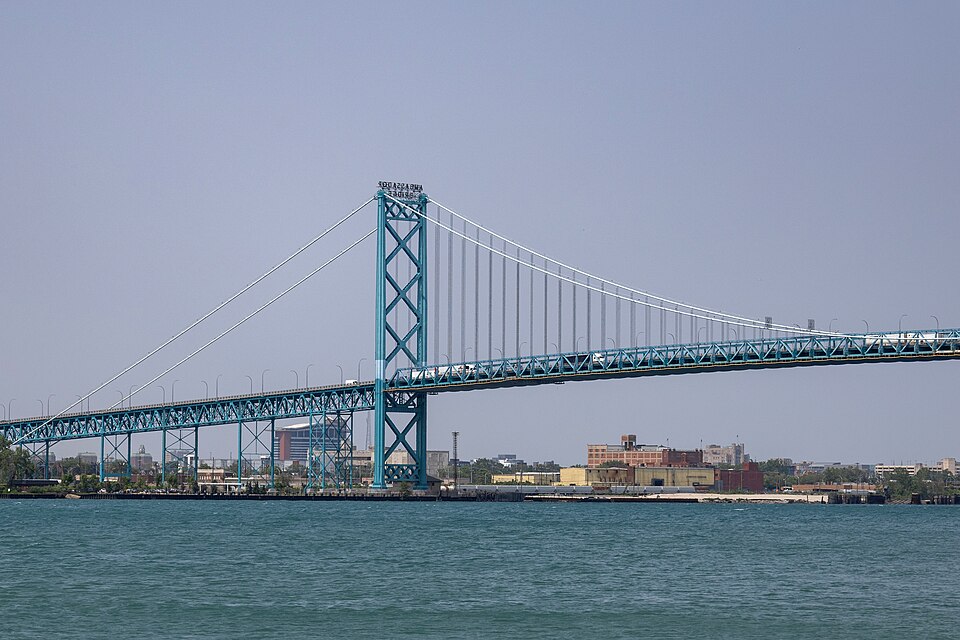
The sheer density of cross-border commerce is captured by a single statistic: trade across the Ambassador Bridge between Windsor and Detroit alone equals all U.S.-Japan trade. The bridge is a reminder that for all the political drama, economic gravity has consistently pulled the two nations toward integration. Canada itself is a vast federal dominion of ten provinces and three territories, stretching from the Atlantic to the Pacific and north into the Arctic Ocean.
It shares the longest international land border with the United States and possesses the longest coastline of any nation. Indigenous peoples inhabited the land for thousands of years before British and French expeditions arrived in the 16th century.
France ceded most of its North American colonies in 1763, and Canada formed as a federal dominion in 1867 through the union of British North American colonies. The nation gradually gained autonomy from the United Kingdom, a process that ended when legal dependence on the British Parliament was severed in 1982. It now operates as a constitutional monarchy and a parliamentary democracy, officially bilingual in English and French, and is one of the most ethnically diverse nations in the world due to large-scale immigration.
Its economy is highly developed and ranks among the largest globally.
The Unfinished History of Cross-Border Trade
The 1987 agreement did not eliminate protectionist instincts; it institutionalized a rules-based framework that has survived subsequent political turbulence. The history of tariff disputes and protectionist policies has not faded into irrelevance — it is embedded in the institutional memory of both governments. Looking ahead, the calculus for both Washington and Ottawa remains delicate.
The broader stakes of any new trade friction would be measured not just in billions of dollars, but in the stability of a relationship that has been painstakingly built and periodically rebuilt. For now, the 1987 agreement continues to serve as the foundation, a reminder that free trade between these two neighbors has never been a foregone conclusion, but a political achievement that required navigating the full weight of history.




