
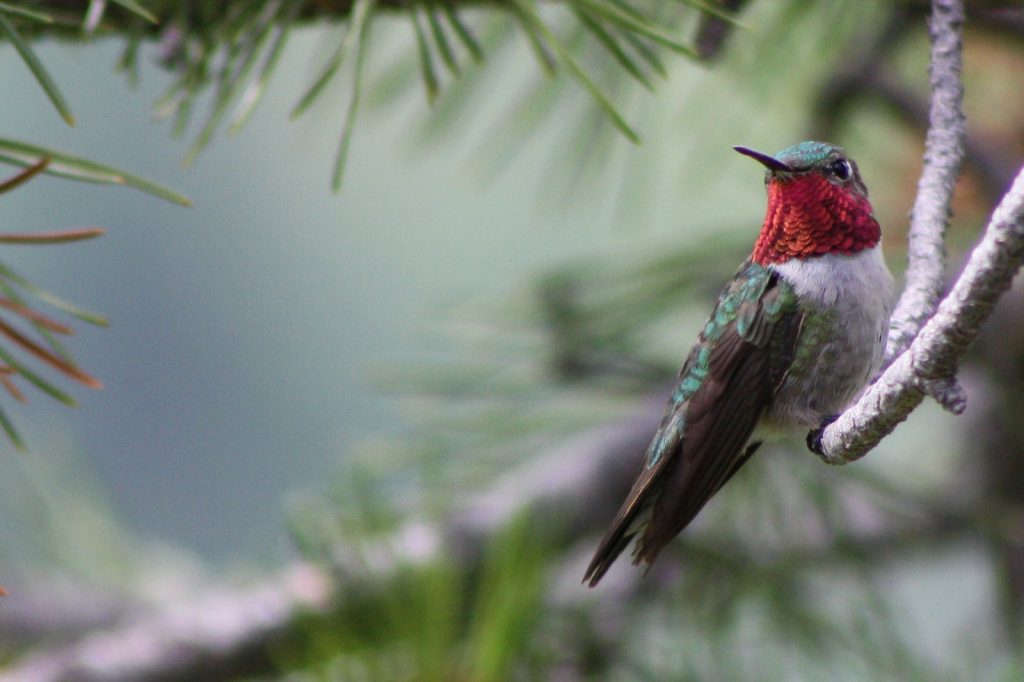
BOULDER, Colo. — The feeders hang silent. The aerial dogfights over backyard sugar-water stations have stopped. For residents across the Front Range, the absence is personal.
A bird that once seemed as reliable as summer itself has become a question mark. Local field guides still list the broad-tailed hummingbird as a common summer resident.
But common is a word that no longer fits the experience of many Coloradans. The question on neighborhood forums isn’t academic. It is: why did they leave my yard?
The available research points to a story playing out at different speeds in different places. This isn’t a single species in freefall everywhere.
It is a mosaic of local disappearances and local shifts. And the causes are tangled together like roots. Habitat loss hits hard and close to home.
Open land in Boulder County gets bulldozed for housing developments. The native wildflowers that hummingbirds evolved with — penstemon, scarlet gilia, Indian paintbrush — get scraped away. Replace them with a lawn and a few non-native ornamentals, and you have created a desert for a bird that needs a constant supply of high-energy nectar.
Pesticides are the second punch. They don’t just kill insects.
They can seep into the nectar itself. Even if a hummingbird avoids a sprayed flower, it loses the tiny spiders and insects that are essential food for its chicks. A nest full of young hummingbirds needs protein, not just sugar water.
Remove the bugs, and the next generation starves. Climate change adds a layer of unpredictability that is hard to plan around.
Hummingbirds migrate based on daylight length. That is an ancient, fixed clock. But flowers bloom based on temperature.
A warm spring in the Rocky Mountains can push wildflowers to open and wilt weeks early. A hummingbird that follows the sun north arrives at a buffet that has already closed. This mismatch is not theoretical.
It is happening now. Increased competition among the birds themselves is another factor.
As good habitat shrinks, the remaining patches get crowded. The dominant birds — often the larger, more aggressive ones — push the smaller ones out. What looks like a population crash in one canyon might be a relocation to another.
But if every canyon is degraded, there is nowhere to go. The practical upshot for the average person in Colorado is this: what feels like a local vanishing act is often a localized shift driven by these bigger, harder-to-see forces.
The feeder that was mobbed in June might sit untouched in July. That doesn’t mean hummingbirds are extinct. It means the conditions that brought them to your specific yard have changed.
For those who want to see them return, the research suggests a different approach. Stop thinking of a feeder as a standalone solution. Think of the whole yard.
Native plants that bloom across the full season — early, middle, late — provide a continuous fuel supply. Eliminate pesticides entirely.
Leave spider webs standing. Let a corner of the property grow wild.
The birds are small. The pressures on them are large. But the connection between what happens in a single backyard and what happens across the species’ range is direct. The silence at the feeder is a signal. It is worth reading.




