
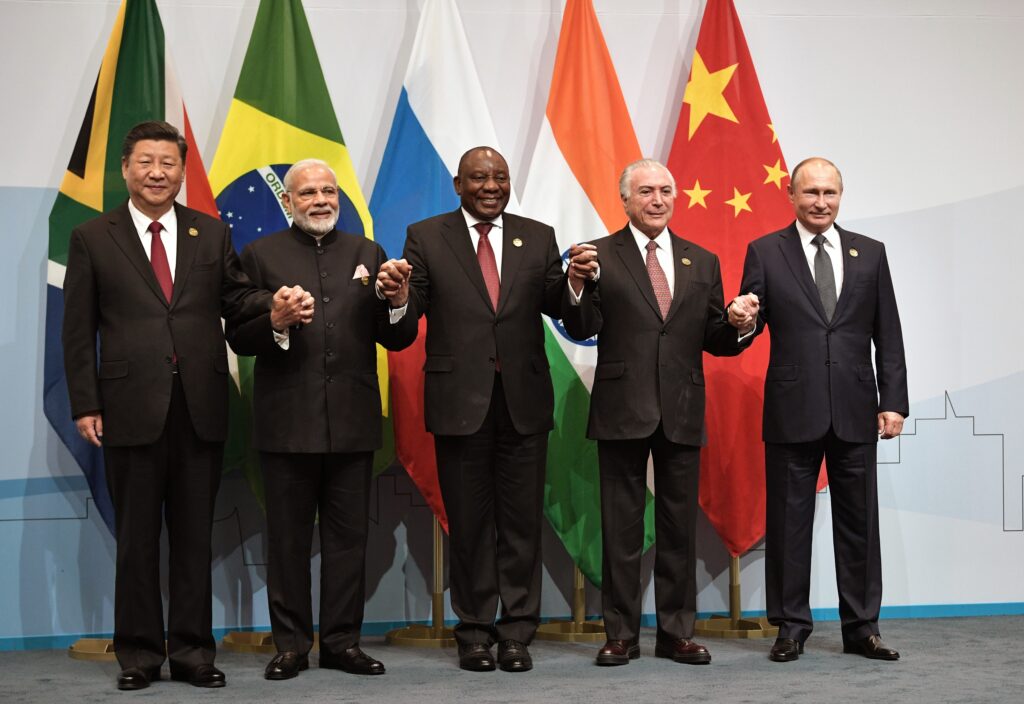
NEW DELHI, September 19 — The 18th BRICS summit was held in New Delhi on September 12 and 13, and the declaration issued at the end of the meeting runs to 140 numbered paragraphs, ranging across global governance, the UN, the IMF, trade, finance, development, climate change and technology. It is the 18th annual declaration in the series, and by the standard measure of these things — the number of commitments a summit produces — it is a large one.
The first summit, at Yekaterinburg in 2009, produced 15 commitments, according to the BRICS Research Group at the University of Toronto. Its count rises to 137 for Kazan in 2024, while the Brazilian chair counted 126 commitments in the 2025 Rio declaration.
That growth reflects the widening of BRICS’s agenda as the grouping has expanded and accumulated working groups, institutions and areas of cooperation. BRICS began as a four-country grouping of Brazil, Russia, India and China, became BRICS when South Africa joined in 2011, and expanded substantially in the 2020s.
What the declarations actually bind
Not much, in the legal sense. BRICS has no treaty comparable to that of a military alliance and no central authority that can enforce its decisions. Its main instrument is political agreement, which makes it easy to measure because every summit produces a document containing commitments — and easy to over-read, because a longer declaration does not necessarily mean a more effective organisation.
The BRICS Research Group has counted commitments in the summit declarations since 2009 and, since the 2011 Sanya summit, has assessed compliance with a selection of them, scoring each member for whether it has fulfilled, partly fulfilled or failed to fulfil the commitments being assessed.
Compliance across the grouping reached 89 per cent after the Goa summit in 2016 and 85 per cent after Johannesburg in 2018, then fell to 40 per cent after the 2023 Johannesburg summit before recovering to 61 per cent after Kazan in 2024, the first cycle assessed across the expanded membership rather than the original five countries.
India recorded full compliance after Sanya in 2011 and 95 per cent after Goa in 2016, when it held the chair; it then fell to 25 per cent after the 2023 Johannesburg summit, the lowest among the five members that year, before returning to 69 per cent after Kazan. A chair year lifts the host’s score in almost every cycle — a pattern worth remembering as Delhi takes its turn.
The bank, and the gap that matters
A second test asks what the grouping has built that outlasts the declaration announcing it. The New Development Bank was agreed at Fortaleza in 2014, with an initial authorised capital of $100 billion and a subscribed capital of $50 billion shared equally among the five founding members.
It opened in Shanghai and made its first loans in 2016, lending to governments and state entities for infrastructure and sustainable development on the model of the World Bank and the Asian Development Bank, mostly raising funds on bond markets rather than from members. Its annual report for 2025, published in July, records cumulative approvals of $43.0 billion for 139 projects since lending began, with a live portfolio of 115 projects worth $35.59 billion at the end of 2025.
India led in lending approved from 2023 and fell behind China again in 2025; Russia’s line flattens after March 2022, when the bank put its Russian transactions on hold. The distance between approvals and disbursements is the most revealing figure the bank produces. For all the noise about a new world order, the salient point from New Delhi is the familiar one: the commitments are counted, the compliance is scored, and the money moves more slowly than either.
What to watch next is whether the Delhi declaration’s 140 paragraphs translate into a compliance score that holds above the 61 per cent recorded after Kazan, and whether the bank’s disbursement line begins to close on its approvals.




