BioWare, the Edmonton-born studio behind some of role-playing gaming’s most iconic franchises, is closing its doors following an acquisition that reshaped one of the industry’s biggest publishers.
The studio’s final projects, including development on the next *Mass Effect* entry, have been cancelled as EA pivots resources toward sports and established franchises.
End of an Era for Mass Effect and Dragon Age
BioWare’s legacy is built on a string of titles that defined a genre. The studio released *Baldur’s Gate* in 1998 and its sequel in 2000, followed by *Star Wars: Knights of the Old Republic* in 2003. Original series such as *Jade Empire* arrived in 2005, with the first *Mass Effect* launching in 2007 and *Dragon Age: Origins* in 2009. The team later entered the massively multiplayer space with *Star Wars: The Old Republic* in 2011.
In recent years, the studio’s reputation fluctuated. *Mass Effect: Andromeda* in 2017 polarized fans with its narrative choices, while *Dragon Age: The Veilguard*, released in 2024, earned favorable critical scores but fell short of EA’s sales expectations. Earlier, *Anthem* (2019) launched in a troubled state and was abandoned by the studio in 2021. These releases coincided with a broader industry shift toward longer development cycles—often five years or more—requiring massive sales to sustain studios. When those expectations are not met, closures follow.
EA’s Strategic Pivot Following the PIF Acquisition
The closure arrives in the wake of EA’s August 2026 acquisition by a consortium led by Saudi Arabia’s Public Investment Fund. The $55 billion deal brought together Silver Lake and Affinity Partners, the latter headed by Jared Kushner, son-in-law of President Donald Trump. In the months following the takeover, EA indicated a refocusing of its development portfolio.
According to EA’s blog post, the company intends to “deepen” its core of sports titles, including EA Sports FC and Madden NFL. The statement emphasized “disciplined investments that only scale when they demonstrate real potential.” Notably, the announcement made no mention of future role-playing games, signaling a strategic withdrawal from the genre BioWare pioneered.
Fan Reaction and the Timing of N7 Day
The shutdown has drawn immediate response from the player base. Fans noted that the announcement came just weeks before N7 Day, the annual celebration of the *Mass Effect* series. Social media platforms have been used to commemorate the studio’s history, with particular attention to its work on companion characters and queer representation—a hallmark of BioWare’s design philosophy that resonated strongly with its audience.
The timing has added a layer of poignancy for a community that has watched the studio’s fortunes decline over the last decade. While EA frames the move as a business realignment, the human element—approximately 400 positions eliminated, roughly 50 within BioWare itself—remains the central outcome.
What Comes Next for Displaced Staff
For the developers who spent years crafting *Mass Effect*’s galaxy or *Dragon Age*’s Thedas, the immediate future is uncertain. EA has not detailed specific reassignments, though the broader restructuring suggests roles may shift toward sports titles, *The Sims*, or the skateboarding series *Skate*. The studio’s history of narrative-driven design and character customization leaves a gap in EA’s upcoming lineup, which the company has said will prioritize shooters, sports, and established live-service models.
EA’s Refocus on Sports and Live-Service Models
In the wake of EA’s $55 billion acquisition by a consortium led by Saudi Arabia’s Public Investment Fund in August 2026, the publisher outlined a strategic shift toward its established core brands. According to EA’s blog post, the company intends to “deepen” its portfolio of sports titles, specifically naming EA Sports FC and Madden NFL. The statement emphasized “disciplined investments that only scale when they demonstrate real potential,” signaling a prioritization of franchises with proven commercial performance. Notably, the announcement made no mention of future role-playing games, marking a strategic withdrawal from the genre that BioWare pioneered. The business consortium also included Silver Lake and Affinity Partners, headed by Jared Kushner, son-in-law of President Donald Trump.
EA’s broader restructuring plan further details the reallocation of resources. The company has indicated that roles and development focus may shift toward its sports franchises, The Sims, and the skateboarding series Skate. BioWare’s history of narrative-driven design and character customization leaves a gap in EA’s upcoming lineup, which the company has said will prioritize shooters, sports, and established live-service models. This realignment reflects the industry trend toward longer development cycles and the need for massive sales to sustain studios, a pressure that contributed to the closure of BioWare after its recent releases fell short of expectations.
Origins in Medicine and the First Game
BioWare was founded in 1995 by Ray Muzyka, Greg Zeschuk, and Augustine Yip, who had recently graduated from medical school at the University of Alberta. Their background included creating a medical simulation program for their education, which provided them with the funding needed to launch a video game company. To make their first game, they pooled their resources, $100,000 each, resulting in capital of $300,000. The company was incorporated on 1 February 1995.
Their initial project, Shattered Steel, began as a proof-of-concept demo and was submitted to ten publishers before signing a deal with Interplay Entertainment. Brent Oster and Trent Oster formed Pyrotek Studios to continue developing the title, but the partnership broke up a year later, with Trent joining BioWare as an early employee to finish the game. BioWare’s first game was released the following year, described by IGN as a “modest success” with “decent sales.”
The founders and staff were keenly interested in role-playing games and became determined to create a similar experience for the PC. They created a demo called Battleground: Infinity, which they presented to Interplay. The publisher had just acquired Dungeons & Dragons from Strategic Simulations and suggested it as a strong fit, leading BioWare to rework the game to fit the rules and setting, titled Baldur’s Gate. Development of Baldur’s Gate continued for three years.
Sources
- BioWare
- BioWare Update
- EA Shutters BioWare, Creator of Mass Effect, Dragon Age, KOTOR and More – CNET
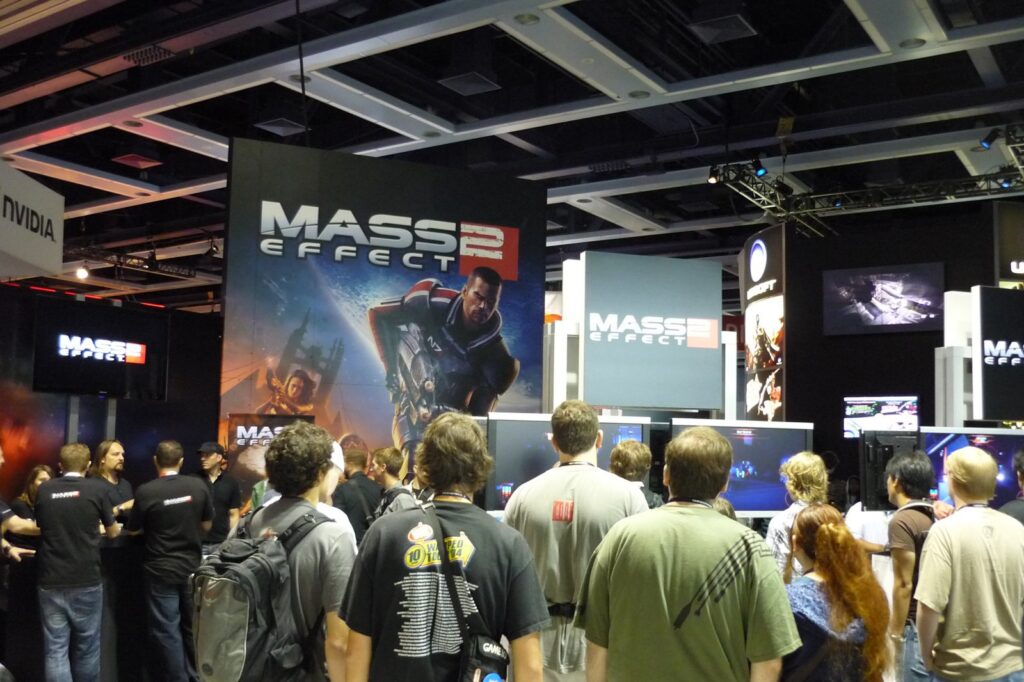
Photo: Alex from Calgary, Canada (CC BY 2.0)