
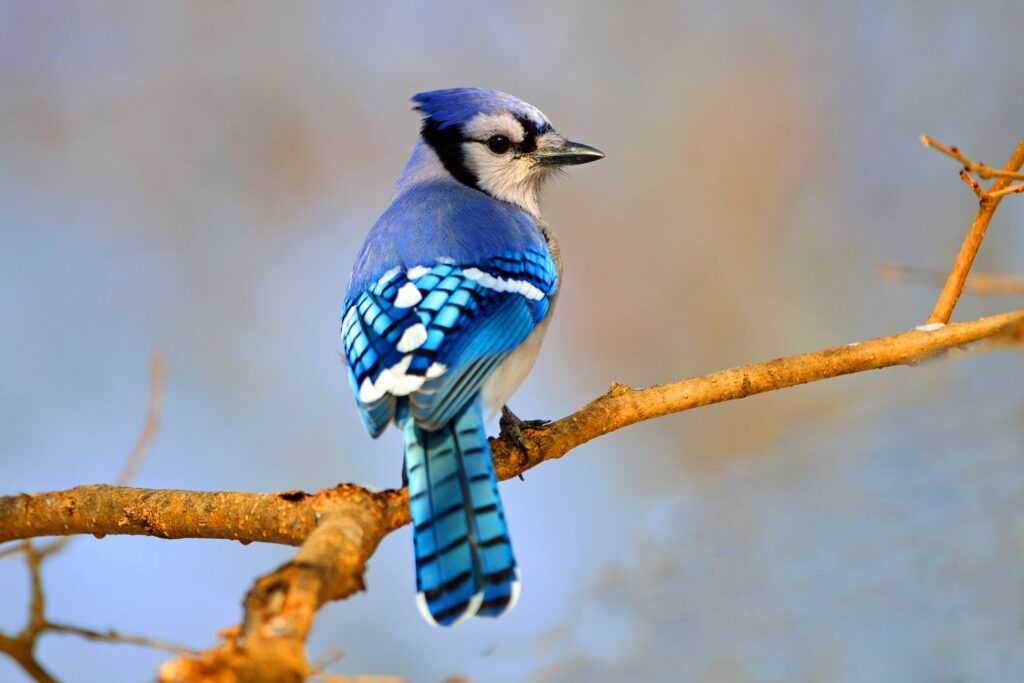
A flash of blue at a backyard feeder near Boston. The immediate assumption: a Blue Jay. But this time, the bird was a Steller’s Jay, a species native to the West Coast, blown east by a spring storm.
The June 29 report from Brookline, Mass., documented the confusion. It also raised a question that cuts deeper than a single misidentification: how many other birds look like a Blue Jay, and why does it matter?
The answer, according to the report, lies in the corvid family. Crows, ravens, and jays share a common lineage. They are intelligent, adaptable, and often blue.
The Steller’s Jay carries the same bold blue body and prominent crest. But its head and breast are sooty black, not the white face and necklace of the Blue Jay.
A birdwatcher in the Rockies might call it a Blue Jay. An observer in New England would know the difference. The California Scrub-Jay is a different case.
It has no crest. Its blue head, wings, and tail contrast with a gray back and whitish underparts. It lacks the Blue Jay’s black bridle and white wing bars.
The Canada Jay, or Gray Jay, is a fluffier, softer gray-blue bird. No crest at all.
Its resemblance is more in size and shape than in color. These distinctions are not trivial. The Blue Jay’s crest is the most immediate clue.
No other common corvid in its range sports one. But from a distance, or with a quick glance, the similarities blur.
That is the point of convergence and mimicry in the natural world. Birds evolve similar features for different reasons. A crest might signal dominance.
Blue feathers might attract mates or camouflage in open sky. The result is a family of birds that look alike but are not the same. The report did not name the person who spotted the Steller’s Jay.
It did not give a quote. The facts stand on their own.
A spring storm carried a West Coast bird east. It landed in a Boston suburb. Someone saw it, grabbed a field guide, and realized the mistake.
This is not a rare event. Storms displace birds every year.
Warmer winters and shifting climates push species into new ranges. The Blue Jay’s range is eastern and central North America. The Steller’s Jay is native to the West Coast.
Their paths cross only when weather intervenes. Or when a birdwatcher travels and sees a familiar crest on an unfamiliar bird. The report emphasizes that the natural world is full of such examples.
Convergence and mimicry are not accidents. They are strategies.
A bird that looks like a Blue Jay might gain protection from predators who avoid the aggressive corvid. Or it might compete for the same food sources. The sunflower hearts at the feeder in Brookline were a draw.
The Steller’s Jay found them. It ate.
The observer learned. For the casual birdwatcher, the lesson is simple. Look at the crest.
Check the face. Note the wing bars. A Blue Jay has a white face and a black necklace.
A Steller’s Jay has a sooty black head and breast. A California Scrub-Jay has no crest and a gray back.
A Canada Jay is soft and gray-blue, with no crest at all. These are the facts. They are not opinions.
They are the difference between a correct identification and a story to tell at the next bird club meeting. The report from Brookline is a snapshot.
One bird. One feeder. One morning.
But it opens a wider view. The corvid family is full of look-alikes. They share a common ancestor.
They share intelligence. They share a tendency to show up where they are not expected.
A spring storm is one reason. Climate change is another. Human activity is a third.
The feeders we put out, the trees we plant, the cities we build — all of it shapes where birds go and what they look like when they get there. The Blue Jay is a familiar sight across eastern and central North America.
Its vibrant blue, black, and white plumage is unmistakable up close. But from a distance, or in a moment of surprise, the eye sees what it expects. The Steller’s Jay in Brookline was a reminder.
The natural world does not follow our expectations. It follows its own rules. And sometimes, those rules send a West Coast bird to a Boston feeder.




