
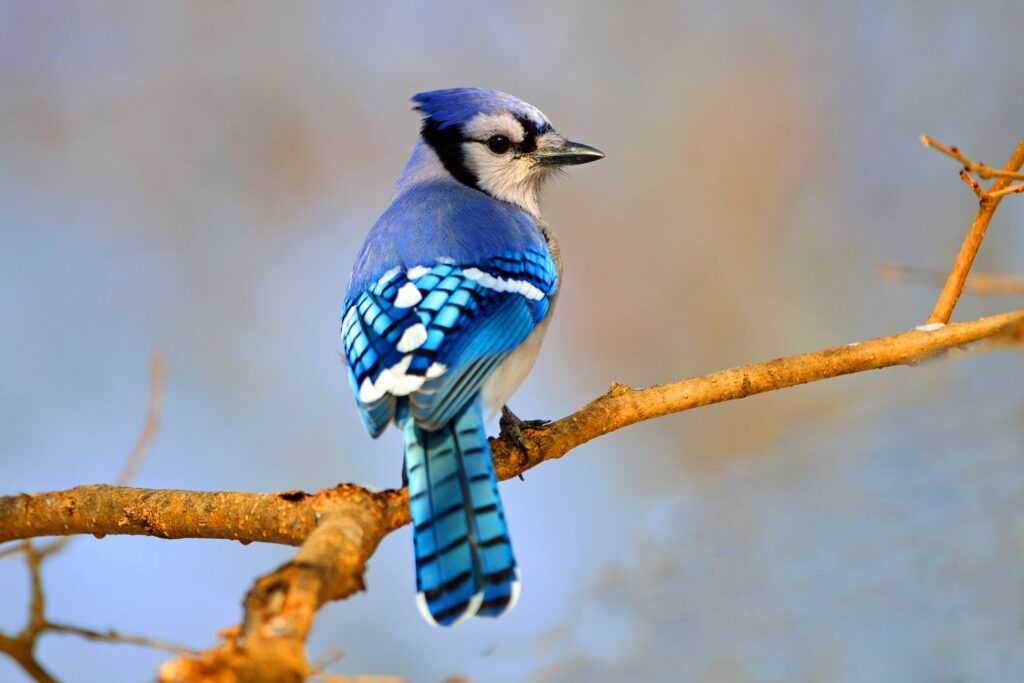
BROOKLINE, Mass. — The Steller’s Jay has no business being in New England. Yet there it was, a West Coast bird blown east by a spring storm, perched at a feeder and eating sunflower hearts. The confusion it caused among local birdwatchers was immediate.
The bird looked like a Blue Jay. It was not a Blue Jay.
Ornithologists who study corvids — the family that includes crows, ravens, and jays — say the mix-up is common. The Steller’s Jay carries the same bold blue body and prominent crest. But its head and breast are a sooty black, not the white face and necklace of a Blue Jay.
A birdwatcher in the Rockies might call one a Blue Jay, an observer in New England would know better. Dr. Patricia Hartley, an avian biologist at the Cornell Lab of Ornithology who has studied corvid identification for fifteen years, said the visual similarities are a classic case of convergent evolution.
“These two species share a common ancestor, but they diverged long ago. The crest is the most immediate clue,” Hartley said. “No other common corvid in the Blue Jay’s range sports that crest.
A quick look at the head tells you everything.” The Blue Jay (Cyanocitta cristata) is a familiar sight across eastern and central North America. Its vibrant blue, black, and white plumage, the distinctive crest, and its vocalizations make it an easily recognizable bird. But the natural world is full of fascinating examples of convergence and mimicry.
Understanding what other birds look like a Blue Jay requires a closer look at avian characteristics. Then there is the California Scrub-Jay.
It is a crestless corvid with a blue head, wings, and tail. But it has a gray back and whitish underparts. It lacks the Blue Jay’s black bridle and white wing bars.
The Canada Jay, also known as the Gray Jay, is a fluffier, softer gray-blue bird with no crest at all. It is a denizen of northern boreal forests.
Its resemblance is more in size and shape than in color. Hartley said distinguishing features go beyond the surface. “The Blue Jay’s crest is the most immediate clue.
But also look at the pattern on the wings and tail. Blue Jays have white wing bars and white tail tips. The Steller’s Jay has no white in the wings at all.
The California Scrub-Jay has no crest and no white bars. The Canada Jay is a different color entirely.” The Steller’s Jay sighting in Brookline was a direct result of the spring storm.
The bird was a vagrant, a lost individual carried far outside its normal range. Birdwatchers scrambled for field guides. Some called it a Blue Jay.
They were wrong. Hartley said the incident is a reminder of how easily even experienced birders can be fooled.
“A flash of blue at the feeder, and you think you know what you’re seeing. But the details matter. The crest, the color of the head, the pattern on the wings.
You have to look closely.” The corvid family is renowned for its intelligence and adaptability. Several members share physical attributes that can lead to confusion, especially from a distance or with a quick glimpse. The Steller’s Jay, the California Scrub-Jay, and the Canada Jay all have blue in their plumage.
But none of them are Blue Jays. For birdwatchers in Brookline, the lesson was clear.
Not every blue bird with a crest is a Blue Jay. Sometimes it is a Steller’s Jay, blown in from the West Coast by a storm. And sometimes the only way to know for sure is to look at the head.




