
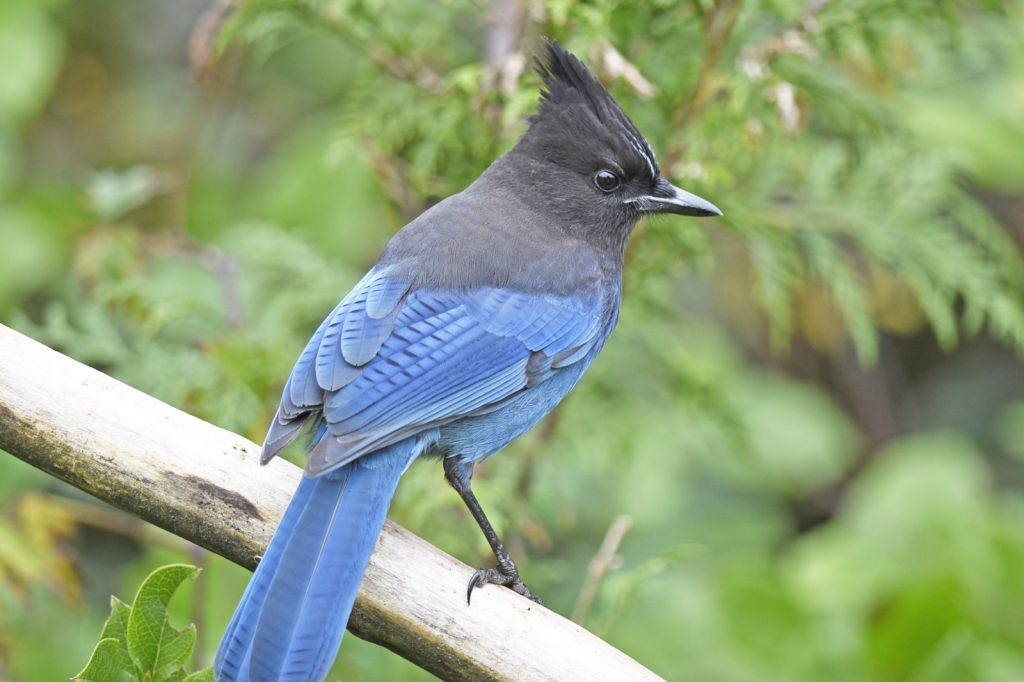
BROOKLINE, Mass. — The bird at the feeder had a crest, blue feathers, and a loud call. But it was in the wrong place. This one, a Steller’s Jay, belongs west of the Rockies.
A spring storm blew it east. For the casual observer, the mistake is easy.
The Steller’s Jay looks like a Blue Jay. It is not. This confusion is not rare.
It is a window into a larger, ongoing story. North American bird ranges are shifting.
Storms, changing climates, and habitat loss push species into new territory. The corvid family — crows, ravens, jays — is adaptable. That adaptability is now on display in suburban backyards.
The Blue Jay is a fixture of the East. Its crest, black necklace, and white wing bars are distinctive. But a quick glance can fool you.
The Steller’s Jay has the same bold blue body and prominent crest. Its head and breast are sooty black, not white.
A birdwatcher in the Rockies might call it a Blue Jay. An observer in New England knows better. Then there is the California Scrub-Jay.
No crest. Blue head, wings, and tail.
Gray back. Whitish underparts. It lacks the Blue Jay’s black bridle and white wing bars.
The Canada Jay, also called the Gray Jay, is fluffier. Soft gray-blue. No crest.
It lives in northern boreal forests. Its resemblance is more in size and shape than color.
These distinctions matter. Bird identification is not a parlor game. It is the first step in tracking ecological change.
When a Steller’s Jay shows up in Massachusetts, it is a data point. Scientists track these vagrants.
They map shifting ranges. They measure the impact of warming winters and stronger storms. The Blue Jay’s crest is the most immediate clue.
No other common corvid in its range has one. But range is the key word. That range is not static.
The Steller’s Jay is a West Coast cousin. Its presence in the East is an anomaly.
Anomalies are becoming more common. Spring storms are powerful. They can lift birds hundreds of miles off course.
A single storm can deposit a mountain bird in a coastal suburb. The bird finds a feeder.
It eats sunflower hearts. It looks like a Blue Jay. The homeowner grabs a field guide.
Confusion follows. This is not a one-off. The natural world is full of convergence and mimicry.
But the human element is new. Backyard feeders are now monitoring stations.
Ordinary people are collecting data. They see a bird. They wonder.
They look it up. Sometimes they are wrong.
Sometimes they are right. Either way, they are part of a larger pattern. The corvid family is intelligent.
It is adaptable. Those traits help it survive. They also make it a good indicator species.
If jays are moving, something is shifting. The Blue Jay is familiar.
Its cousins are less so. Learning to tell them apart is not just a skill. It is a way of paying attention.
The bird in Brookline is a reminder. Not a moral.
Just a fact. The world is changing. The birds are telling us.
We just have to look closely enough to see which one is at the feeder.




