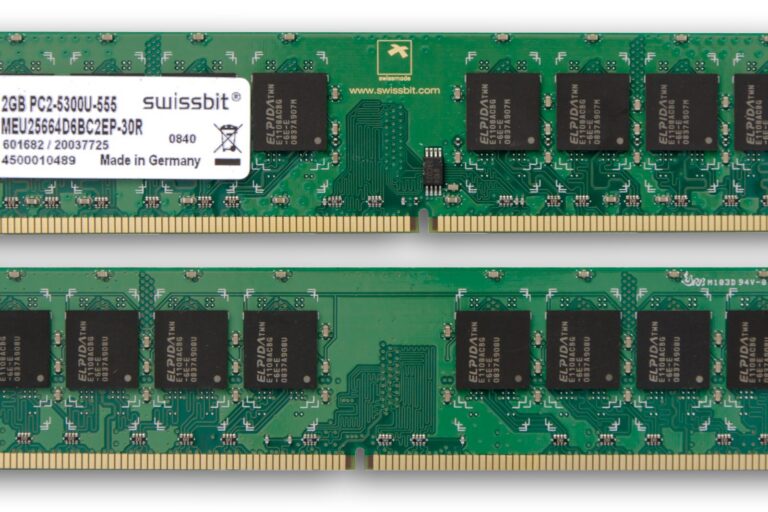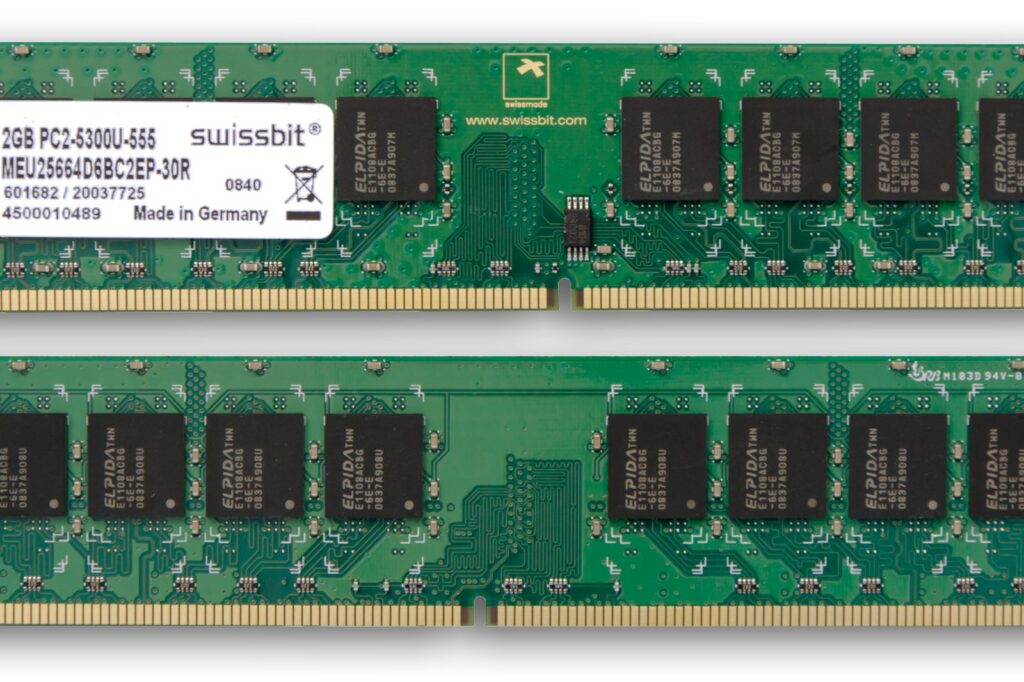
Teamgroup’s launch of a 128GB consumer RAM kit arrives at a moment when the memory market is defined more by scarcity than abundance. Here’s what it means in plain terms.
The Roots of Modern Memory
The story of computer memory begins with the limitations of early machinery. Before semiconductor RAM became dominant, early computers relied on relays, mechanical counters, or delay lines for main memory functions. Ultrasonic delay lines were serial devices which could only reproduce data in the order it was written. Drum memory could be expanded at relatively low cost but efficient retrieval of memory items requires knowledge of the physical layout of the drum to optimize speed. Latches built out of triode vacuum tubes, and later, out of discrete transistors, were used for smaller and faster memories such as registers. Such registers were relatively large and too costly to use for large amounts of data; generally, only a few dozen or few hundred bits of such memory could be provided.
The first practical form of random-access memory was the Williams tube. It stored data as electrically charged spots on the face of a cathode-ray tube. Since the electron beam of the CRT could read and write the spots on the tube in any order, memory was accessible in any sequence. The use of semiconductor RAM dates back to 1965 when IBM introduced the monolithic 16-bit SP95 SRAM chip for their System/360 Model 95 computer, and Toshiba used bipolar DRAM memory cells for its 180-bit Toscal BC-1411 electronic calculator, both based on bipolar transistors. While it offered higher speeds than magnetic-core memory, bipolar DRAM could not compete with the lower price of the then-dominant magnetic-core memory. In 1966, Dr. Robert Dennard invented modern DRAM architecture in which there’s a single MOS transistor per capacitor. The first commercial DRAM IC chip, the 1K Intel 1103, was introduced in October 1970. Synchronous dynamic random-access memory (SDRAM) was reintroduced with the Samsung KM48SL2000 chip in 1992.
Market Hostility and Pricing Pressures
The current hostility toward high-capacity consumer kits stems from a combination of volatile pricing and supply constraints. In modern technology, RAM takes the form of integrated circuit (IC) chips with MOS (metal–oxide–semiconductor) memory cells. RAM is normally associated with volatile types of memory where stored information is lost if power is removed. The two main types of volatile random-access semiconductor memory are static random-access memory (SRAM) and dynamic random-access memory (DRAM). Non-volatile RAM has also been developed and other types of non-volatile memories allow random access for read operations, but either do not allow write operations or have other kinds of limitations. These include most types of ROM and NOR flash memory.
According to industry data, the price of DRAM has fluctuated significantly over the past several years, driven by shifting demand from smartphones and the rapid expansion of AI server infrastructure. When supplier output contracts or demand spikes in the enterprise sector, the ripple effect pushes retail prices upward, making large consumer kits less attractive to price-sensitive buyers.
Supply Constraints and Shifting Demand
Supply limitations have further complicated the landscape for high-capacity consumer memory. The production of DRAM involves complex fabrication processes and precise MOS cell design. Any disruption in the supply chain—whether from fab downtime or geopolitical tensions affecting raw material flows—directly impacts the availability of higher-density modules. Meanwhile, demand trends have shifted. The proliferation of AI workloads and data-center expansions has drawn significant manufacturing capacity away from the consumer channel. As a result, the volumes available for mainstream motherboards and laptops have tightened, leaving enthusiasts and general users competing for a shrinking pool of high-density parts.
What This Means for Buyers
For the average user, the practical upshot is that upgrading to 128GB or beyond is no longer a simple matter of buying a kit and plugging it in. The combination of higher per-gigabyte costs and reduced shelf availability means that large-memory configurations are increasingly reserved for workstation or server builds. Casual gamers and general productivity users may find that 32GB or 64GB remains the sweet spot for performance per dollar. The Teamgroup launch highlights that while the technology to produce such kits exists, the market conditions surrounding them make widespread adoption a significant hurdle.
Definition of Random-Access Memory (RAM)
Random-access memory (RAM) is a form of electronic computer memory that can be read and changed in any order, typically used to store working data and machine code. A random-access memory device allows data items to be read or written in almost the same amount of time irrespective of the physical location of data inside the memory, in contrast with other direct-access data storage media such as hard disks and magnetic tape, where the time required to read and write data items varies significantly depending on their physical locations on the recording medium.
In modern technology, random-access memory takes the form of integrated circuit (IC) chips with MOS (metal–oxide–semiconductor) memory cells. RAM is normally associated with volatile types of memory where stored information is lost if power is removed. The two main types of volatile random-access semiconductor memory are static random-access memory (SRAM) and dynamic random-access memory (DRAM). Non-volatile RAM has also been developed and other types of non-volatile memories allow random access for read operations, but either do not allow write operations or have other kinds of limitations; these include most types of ROM and NOR flash memory.
Sources
- Random-access memory
- Former Ram Nick Martinez To Start In World Series For Tampa Bay – Fordham University Athletics
- Game Recap: Rams defeat Raiders 35-21 in Las Vegas
Photo: An-d (CC BY-SA 3.0)